
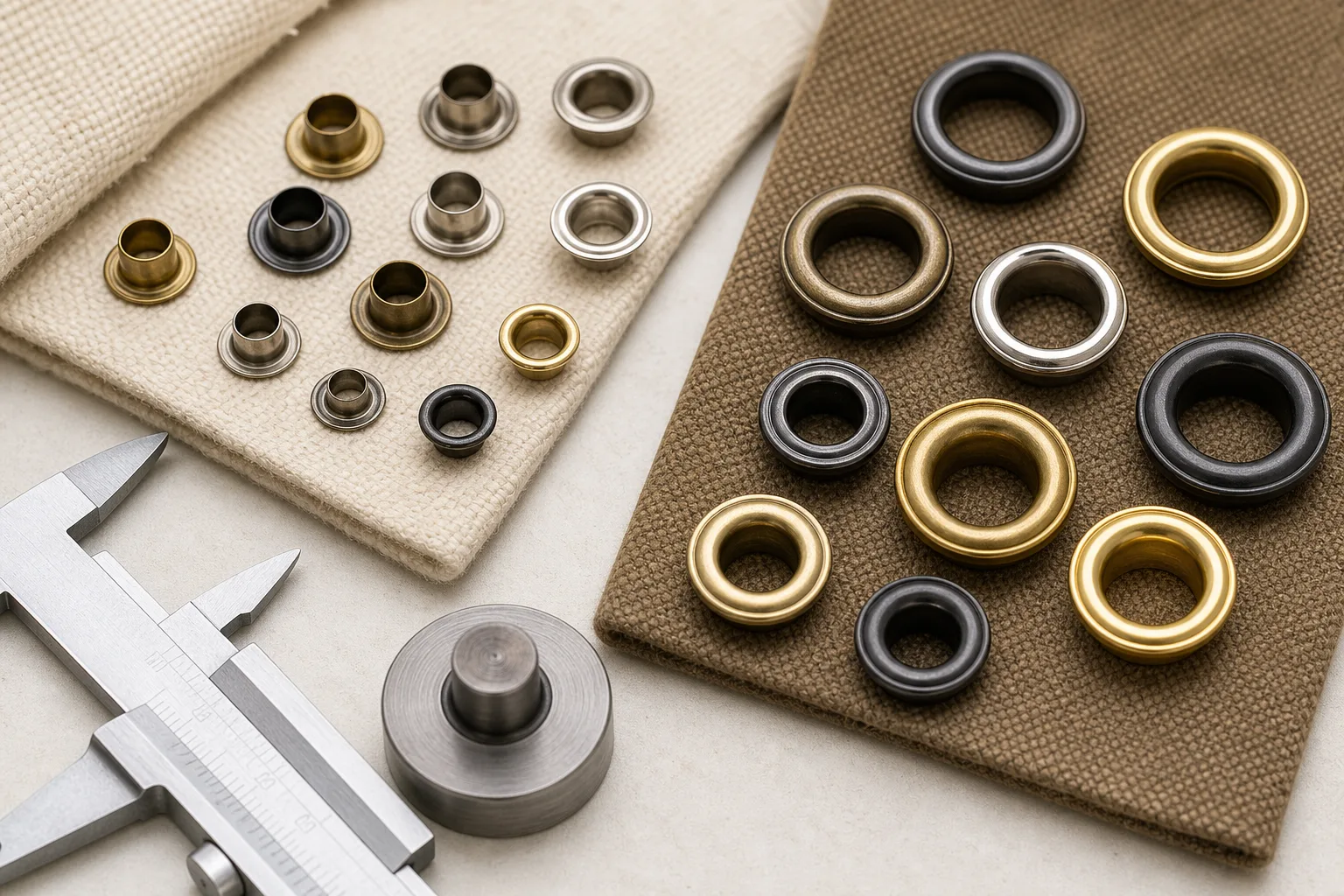
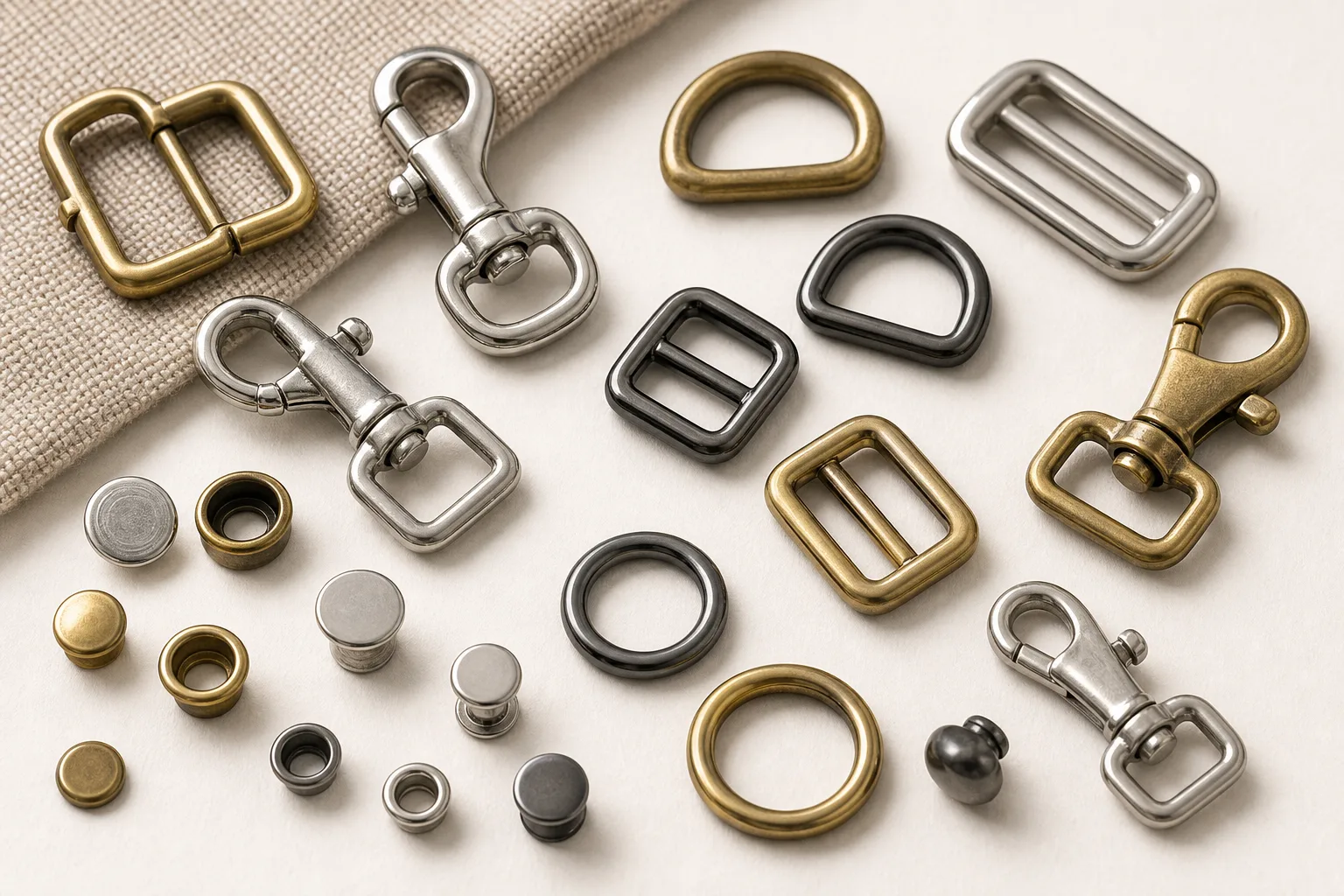
Arguing about which word is correct wastes time, because usage differs by region, by industry and by supplier. What does not differ is the physical difference between a barrel flared against the material and a barrel set into a washer. Specifying by piece count removes the ambiguity in a single line.
Why the words do not settle anything
Some catalogues reserve grommet for the larger, heavier two-piece part and eyelet for the small garment version. Others use grommet for anything set into canvas or industrial fabric and eyelet for anything on apparel. Others use them interchangeably. All of these are in current commercial use.
The consequence is that an inquiry asking for grommets may return either construction. Writing one-piece eyelet or two-piece grommet with washer is unambiguous everywhere and costs one extra word.
What the back washer actually does
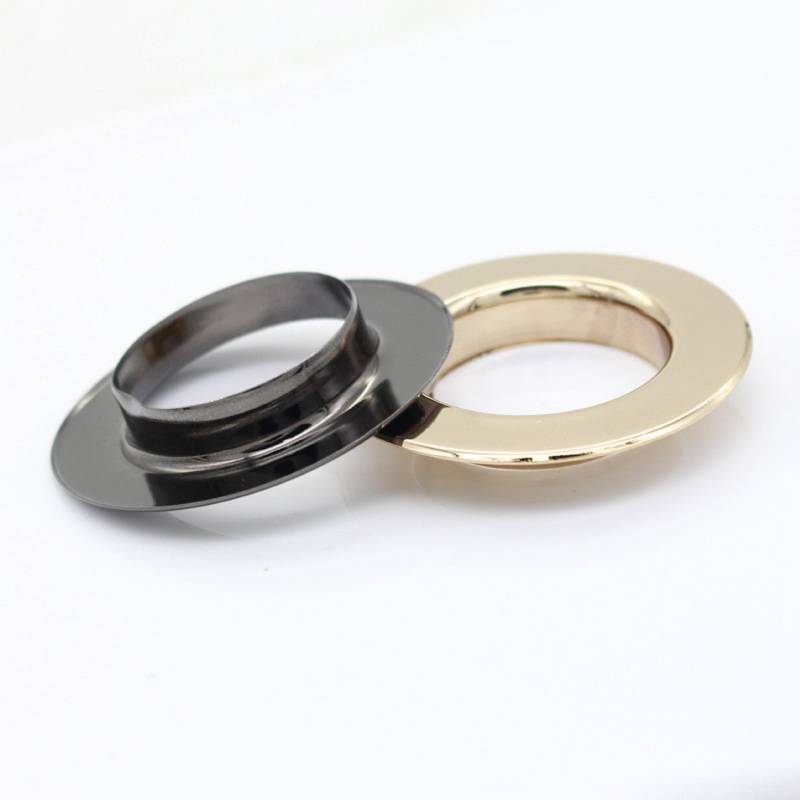
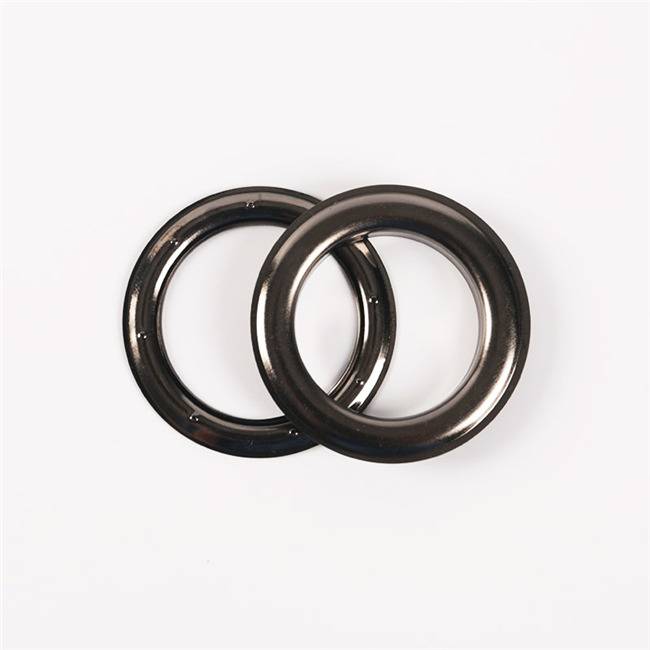
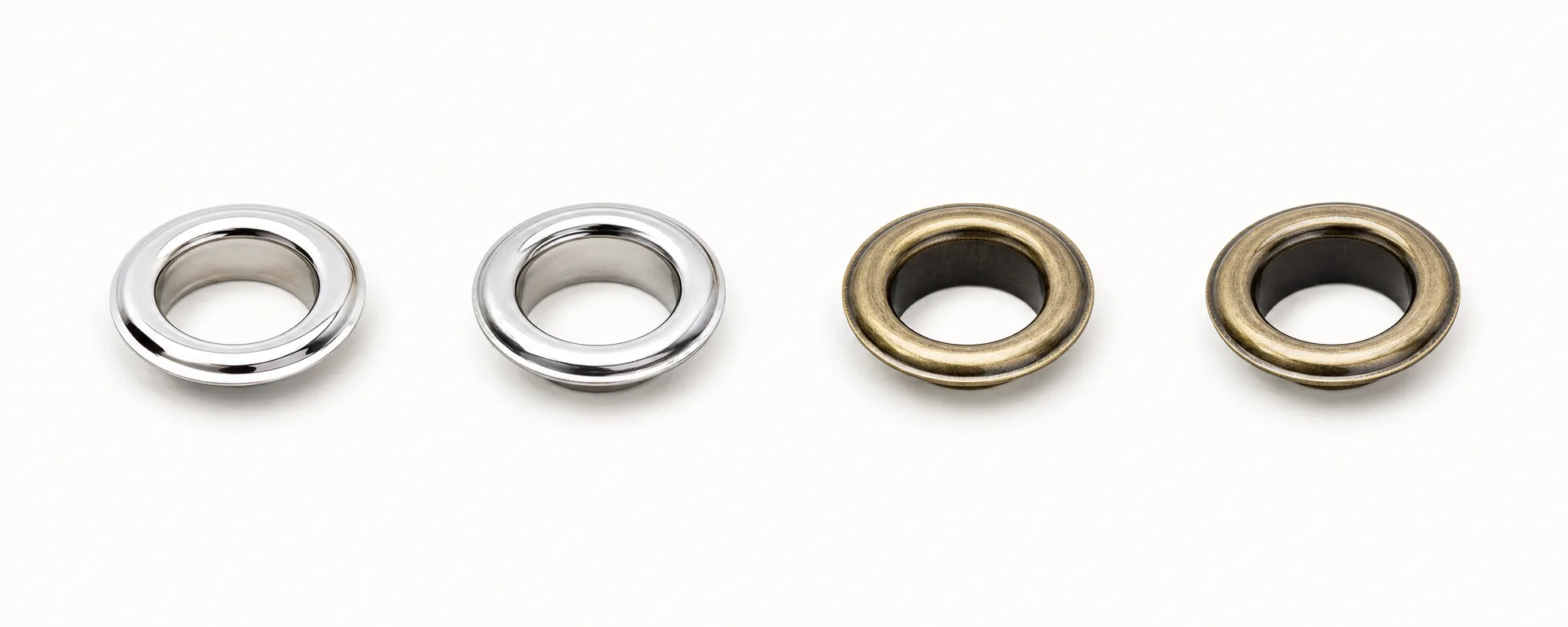
On a one-piece eyelet the flared barrel bears directly on the material. The bearing surface is the rolled lip, which is narrow and can be uneven if the roll is not clean. On a two-piece part the barrel is set into a washer, and the washer spreads the load across a wider, flatter ring.
That extra bearing area is why two-piece parts are used on heavier fabrics, on load-carrying holes and on anything that will be pulled repeatedly. It is also more forgiving of a slightly imperfect set, because the washer geometry does not depend on the roll being perfect.
Material and load: which to use
One-piece eyelets suit light to medium fabrics, garment applications, decorative holes and lacing where the load is modest and shared across many holes. They are faster to set and use fewer parts.
Two-piece grommets suit canvas, tarpaulins, banners, awnings, curtain headings and any hole that carries a significant share of a panel weight. They need a punched hole and a die set, but they hold far better where the load is real.
Setting: what each demands
Both need a punched hole sized to the barrel outer diameter and a barrel length matched to the total material stack. Both are set with a die under press pressure. The difference is that a two-piece part also needs the washer aligned, which is one more thing that can go wrong on a production line and one more reason to check set quality on a sample run.
Over-setting cuts the material; under-setting leaves the part loose. Neither is visible from a distance, which is why set quality should be checked on the reverse face rather than the front.
Appearance on the reverse
The reverse of a one-piece eyelet is a rolled lip; the reverse of a two-piece grommet is a flat washer. On a lined product neither is visible. On an unlined curtain heading, a banner or a tarpaulin, the reverse is seen and the washer generally looks more deliberate.
This is worth stating explicitly in an inquiry, because a supplier optimising for cost will not know the back face is visible unless told.
What to specify either way
One-piece or two-piece, inner diameter, barrel length against the confirmed material stack, the material and its reinforcement, whether the hole carries load and in which direction, whether the reverse is visible, number of holes per product, and material and finish direction.
A made-up sample of the actual position — a heading, a corner, a panel edge — settles barrel length and set quality faster than a written specification.
Do not rely on the words. Specify one-piece or two-piece, and choose by load and material: one-piece for light fabrics and modest loads, two-piece where a washer is needed to spread real load across a wider bearing surface.
 Buyer Guides
 Buyer Guides
 Application Guides
 Application Guides
 Buyer Guides
 Comparison Guides