
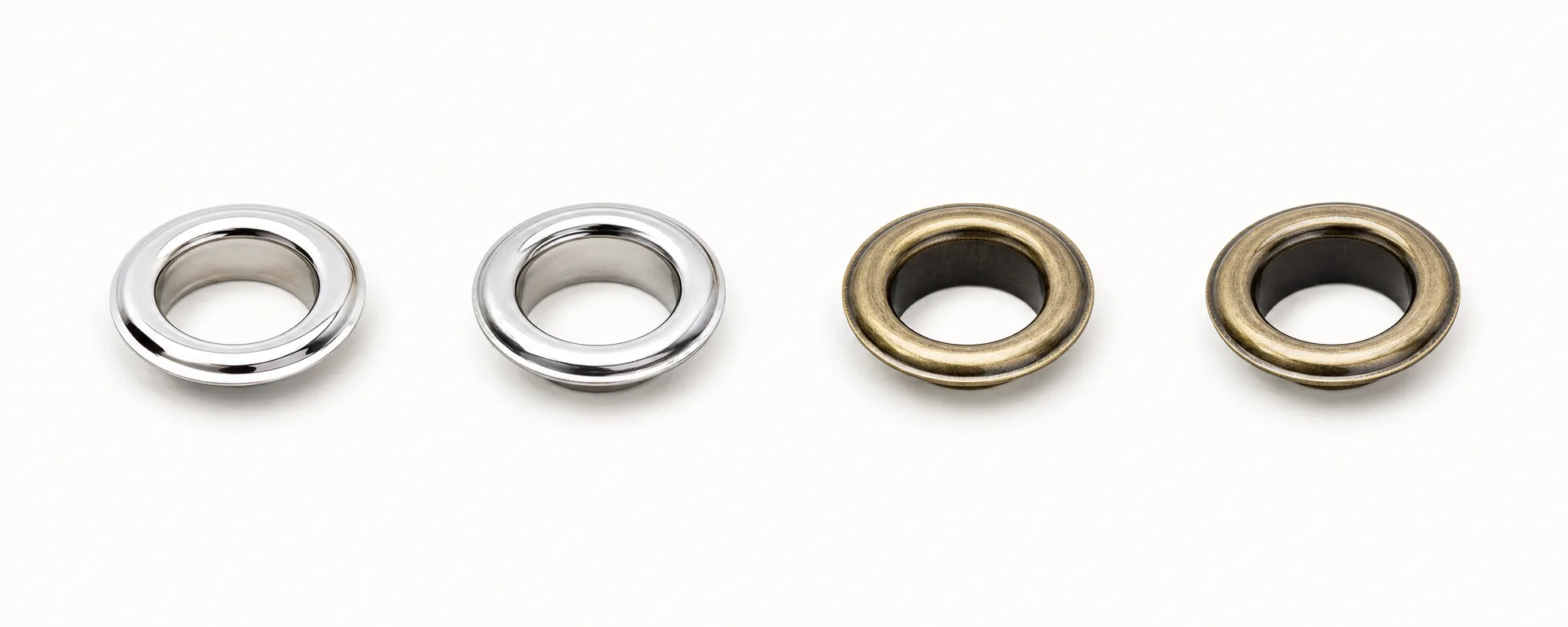
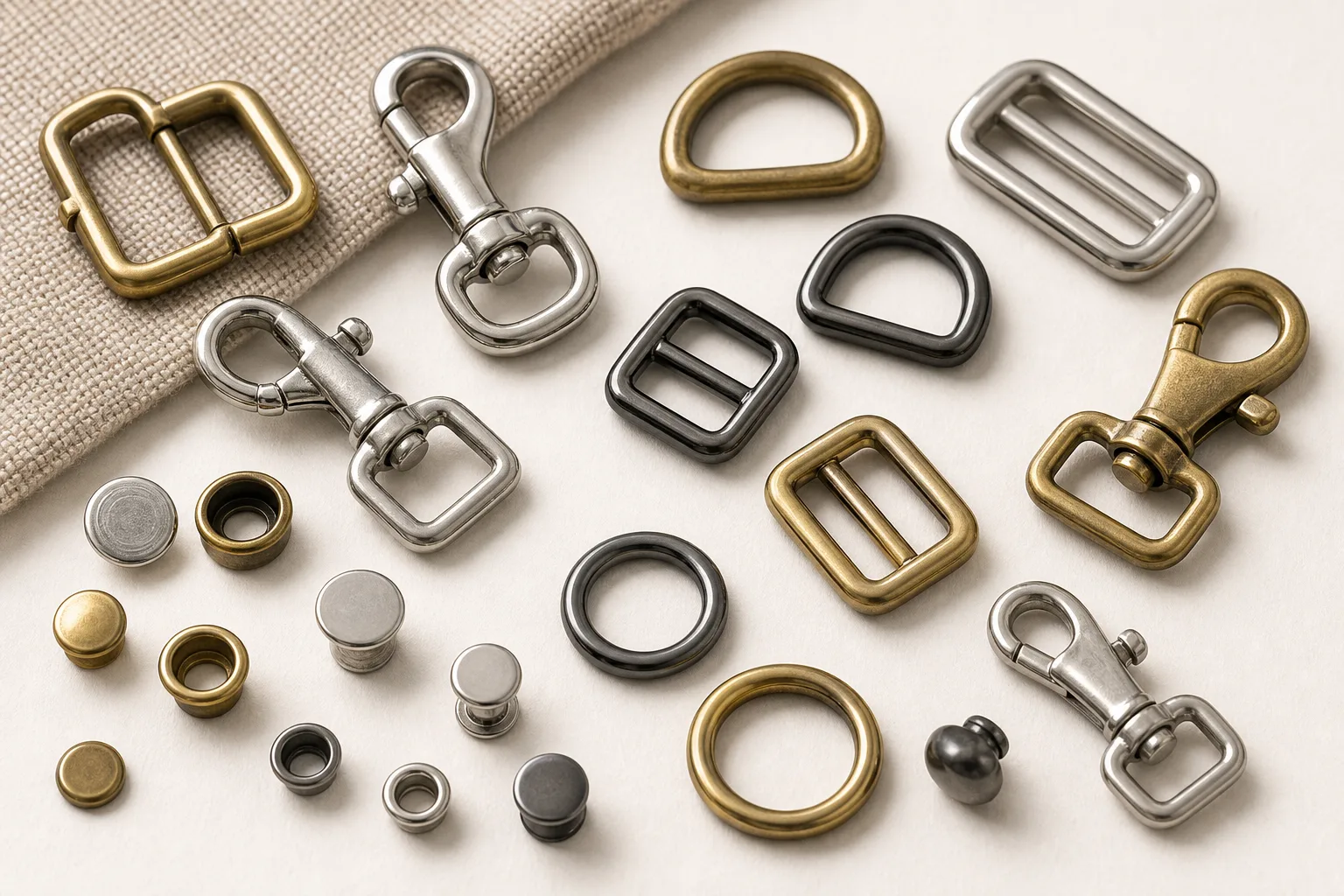
Eyelets look like the simplest part in a hardware list, which is why they are often the part that fails. The ring itself is rarely the problem: what fails is the relationship between the hole, the material and the setting process. This guide covers what the part is for, where it is used, and which details decide whether the hole is still intact after a season of use.
What the ring is actually doing
Cutting a hole in fabric or leather creates a cut edge, and a cut edge concentrates load. Pull a cord through a bare hole and the load arrives at a few threads on one side; those threads fail, the hole elongates, and the failure runs. An eyelet replaces that concentration with a rigid ring that spreads the pull around the full circumference and moves the contact point away from the cut edge entirely.
That is why the setting matters as much as the ring. An eyelet that is loose in the hole does not spread anything — it rattles and lets the material work against the flange. An eyelet set too hard cuts the material it was meant to protect. Both look acceptable on the bench and fail in use.
Eyelet or grommet: the distinction that matters commercially
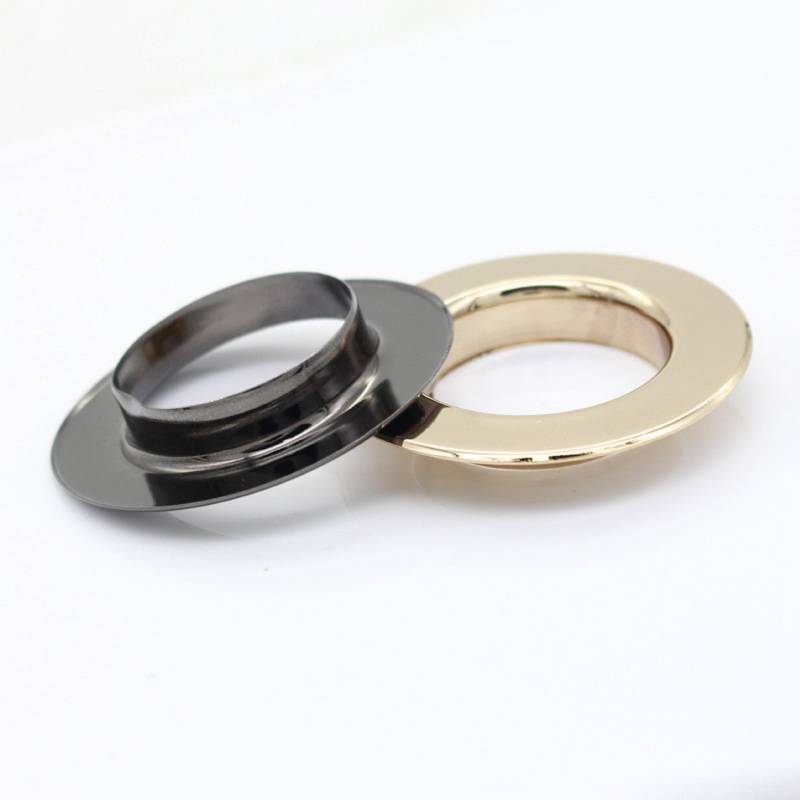
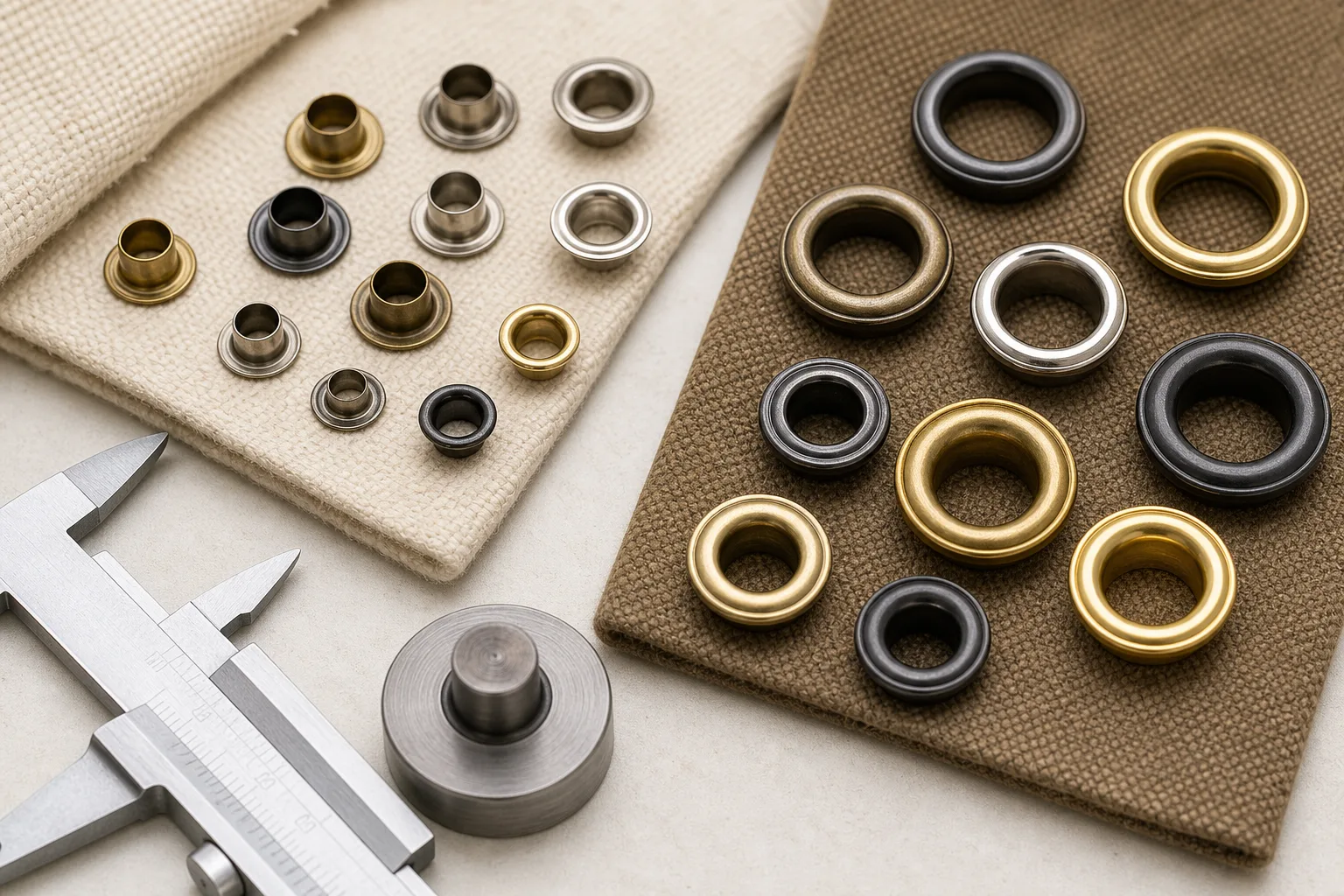
In everyday use the two words overlap heavily and many suppliers treat them as synonyms. The distinction worth holding on to is the number of pieces. A one-piece eyelet is a single ring whose barrel is rolled or flared over on the back face. A two-piece grommet has a separate washer on the back, and the barrel is set into that washer.
The two-piece construction gives a larger, more even bearing surface on the reverse and generally survives heavier or repeated loading. The one-piece is lighter, cheaper and perfectly adequate for light garment work. When you write an inquiry, saying one-piece or two-piece removes more ambiguity than choosing between the two words.
The four jobs they do
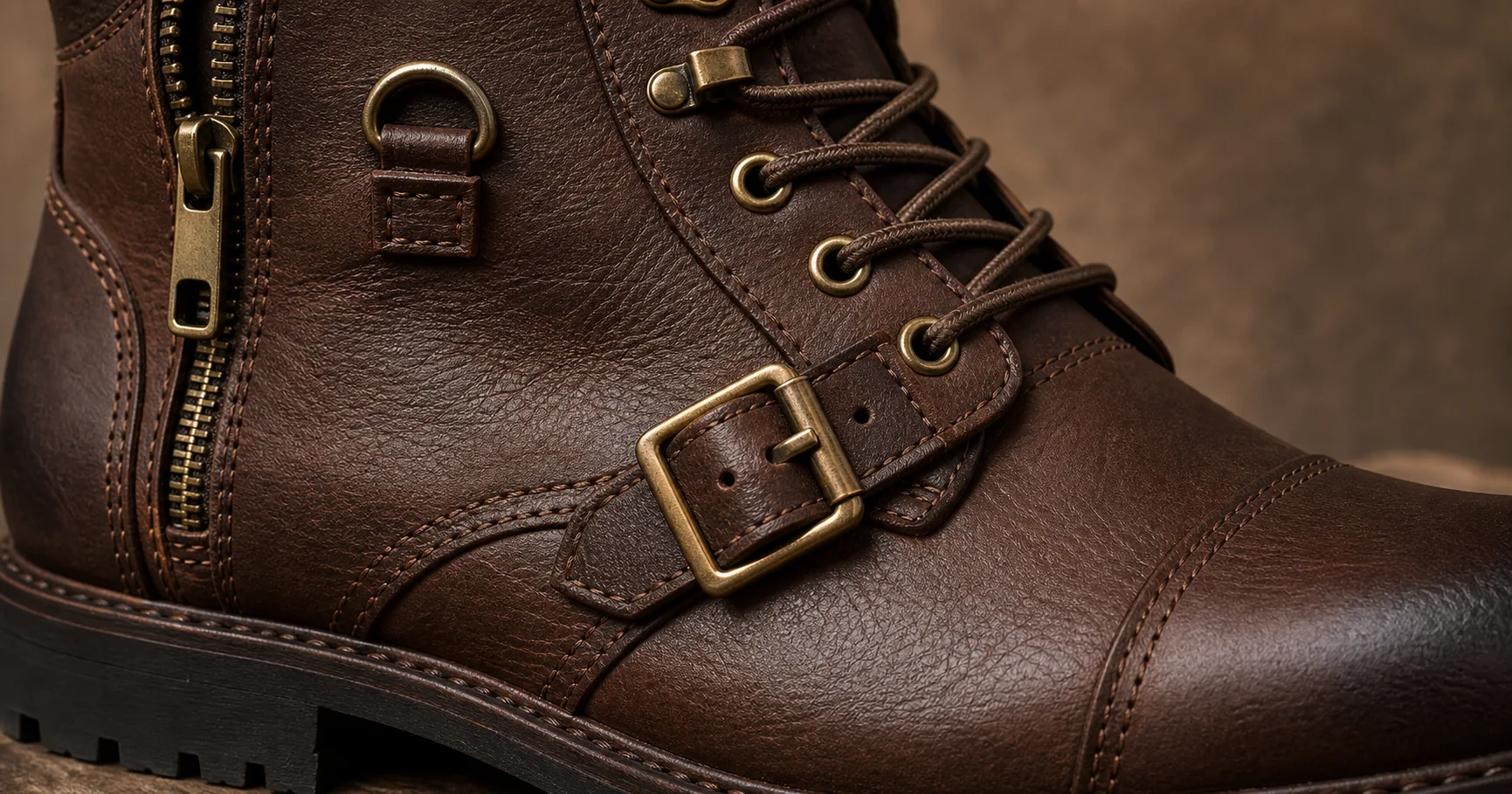
Lacing and drawcords: footwear lacing, hoodie cords, corset backs and bag closures, where cord runs repeatedly through the hole and abrasion is the main concern. Ventilation: eyelets in garment underarms, caps and technical apparel where nothing passes through and the hole exists to move air. Attachment: curtain headings, tarpaulins, banners and awnings where a hook, ring or rope carries the weight of the whole panel through a set of holes. Decoration: eyelet patterns on footwear and fashion accessories where the visible flange is a design feature and the load is minimal.
The job changes what matters. A decorative eyelet is judged on flange finish and colour match; a tarpaulin grommet is judged on how the material holds after a hundred cycles of wind loading. Telling a supplier which job the part does prevents a decorative construction being quoted into a structural position.
Hole size, barrel length and material thickness
Three dimensions have to agree. The inner diameter sets what can pass through — cord, lace or hook. The hole punched in the material must suit the barrel outer diameter, not the inner: too large and the eyelet has nothing to grip, too small and the barrel distorts as it is pushed through. Barrel length has to suit the total thickness of the material stack, including any interlining or reinforcement patch.
This last point causes most of the trouble. A barrel sized for a single layer will not roll properly through a reinforced three-layer heading, and an over-long barrel in thin fabric folds instead of flaring. When you send an inquiry, send the material stack thickness rather than the fabric name alone.
How they fail
Pull-out, where the whole eyelet leaves the material, usually because the barrel was too short, the hole too large, or the material too weak for an unreinforced hole. Elongation, where the hole becomes a slot under repeated one-directional pull. Cracking of the flare on the back face, which comes from over-setting or from a material that is too hard for the roll. Corrosion or plating loss, which is mostly a finish and environment question rather than a structural one.
Reinforcement is often the real answer. On thin or loosely woven material, adding a patch or a bar tack under the eyelet does more than moving up an eyelet size. Suppliers can advise on this but only if they know what the material actually is.
What to prepare before asking for a quotation
Inner diameter, one-piece or two-piece, the material and total thickness the eyelet sets into, whether the hole carries load and in which direction, how many holes per product, and material and finish direction. Say whether the back face is visible — on a lined bag it may never be seen, on a curtain heading it always is.
If you are matching an existing product, an eyelet from that product is the fastest reference. If not, a photograph of the setting area with a ruler, plus the fabric specification, covers most of what a supplier needs to quote sensibly.
Eyelets and grommets exist to keep a hole from becoming a tear. The ring is the easy part; the specification that matters is the relationship between inner diameter, barrel length and the material stack it is set into. Get those three to agree and most eyelet problems never appear.
 Comparison Guides
 Buyer Guides
 Buyer Guides
 Application Guides
 Application Guides
 Buyer Guides