
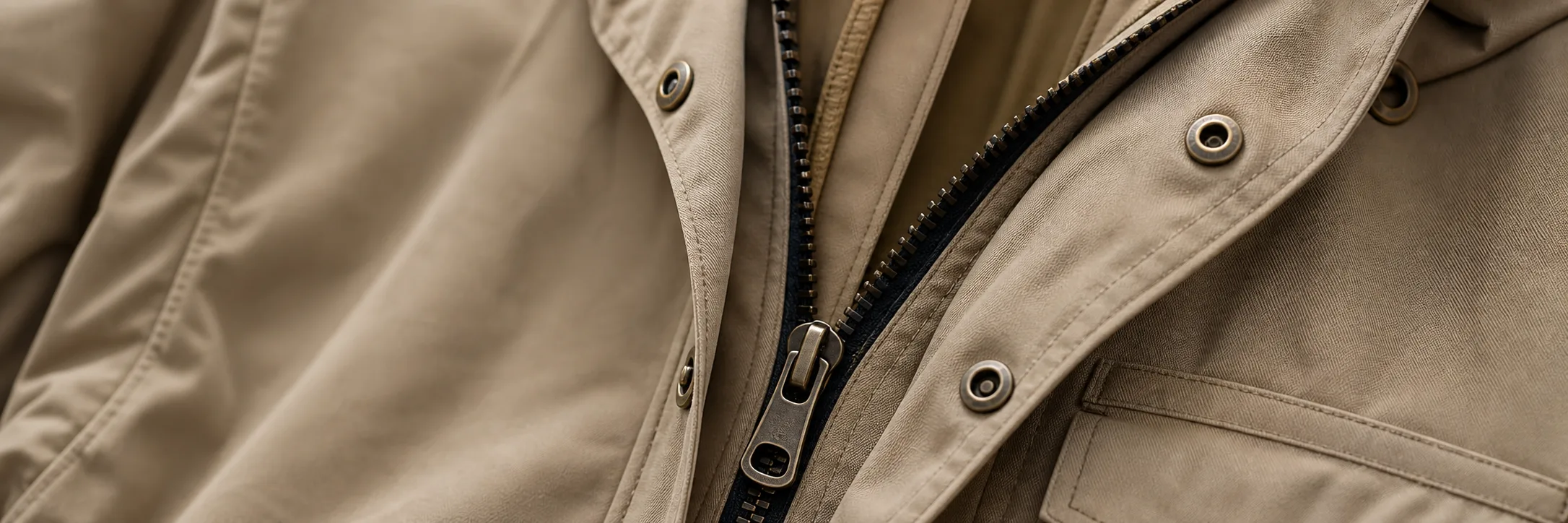
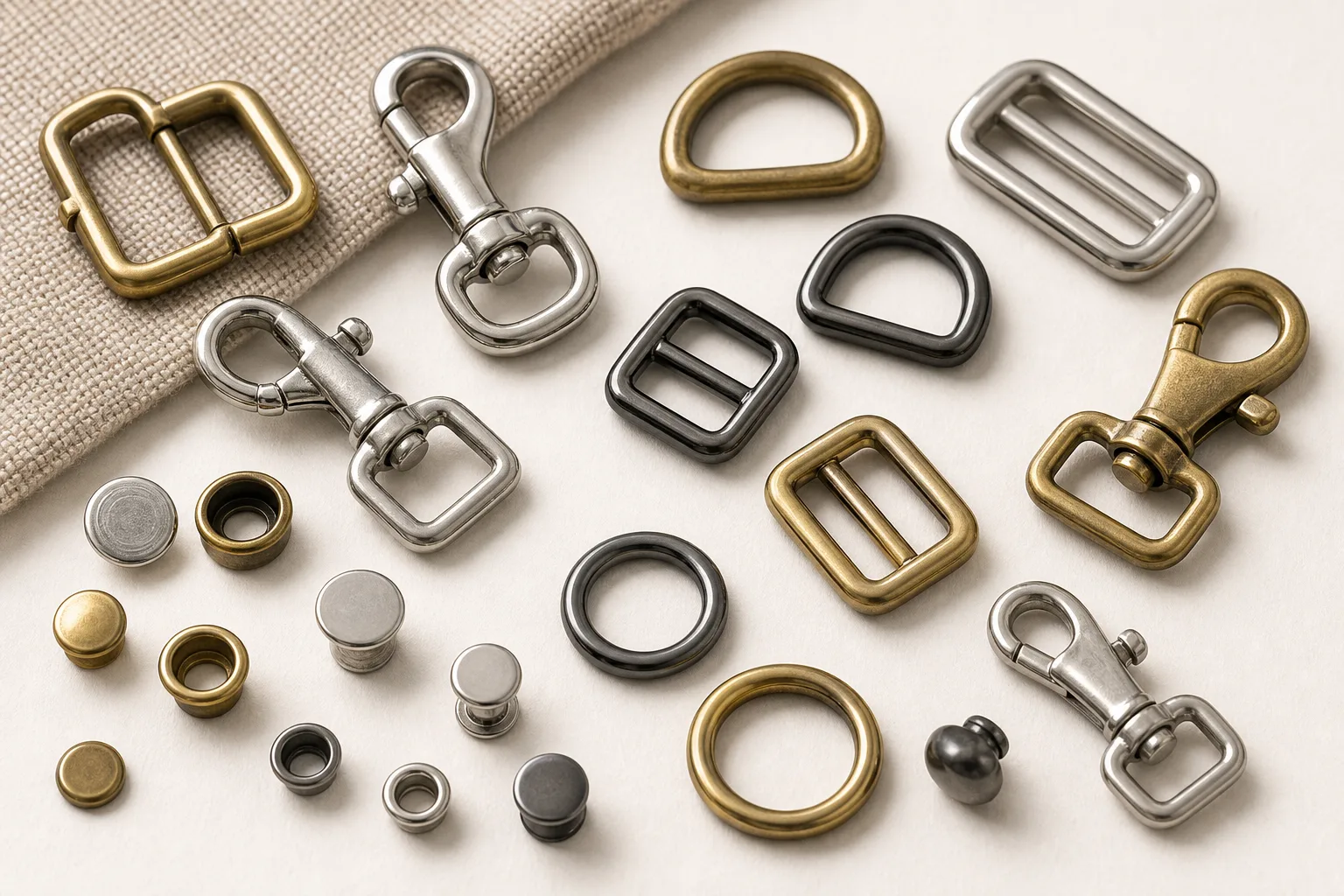
Garment hardware looks like a smaller version of bag hardware and is specified quite differently. Three things change the conversation: the substrate is fabric rather than leather or webbing, the trims go through the garment finishing process after they are attached, and many of them touch skin. Each of those adds requirements that have nothing to do with the part in isolation.
Fabric is a different substrate
Fabric is thinner, more compressible and less dimensionally stable than leather or webbing. A trim that sets perfectly into a two-layer placket may pull through a single layer of the same fabric, and the same trim on a knit behaves differently again because the structure moves.
That is why garment trim specification always comes back to the stack at the exact position — placket, facing, interlining, waistband — rather than to the fabric name. Reinforcement is a normal part of the answer, not an admission that the trim is wrong.
The garment process happens after attachment
Trims are usually attached before the garment is washed, dyed or pressed. Industrial washing, enzyme and stone processes, garment dyeing and high-temperature pressing all act on the trim after it is fixed, and they act on the finish, on any enamel or paint, and sometimes on the joint itself.
On denim this is deliberate — the intended look often depends on how the trim ages through the wash. On other garments it is a risk to be managed. Either way the process belongs in the inquiry, and the sample should be approved after the process rather than before it.
Skin contact and comfort
Many garment trims sit against the body: a bra hook, a waistband button, an eyelet at a cuff. Edge finish, back-face profile and how flat the trim sits all become comfort questions rather than appearance questions.
There are also regulatory and buyer-standard requirements around materials in skin contact, particularly for childrenswear and for certain markets. This guide does not state what any product complies with, because compliance depends on the confirmed material specification and on testing — it is a documentation conversation to have with the supplier and the testing body, not a claim to assume.
Sets, sizes and repeats
Garment programmes usually need a trim family: a main button, a smaller cuff or pocket version, matching rivets, sometimes a matching zipper puller. They are seen together on one garment and often across a whole collection, so consistency spans sizes and seasons rather than just one production run.
Agree the family at the start, approve it as a set, and keep the approved set as the reference for repeat orders. Colour names drift across batches and suppliers; a physical approved set does not.
The factory has to be able to fit them
Set trims — jeans buttons, snaps, rivets, eyelets — need presses and the correct dies, plus an operator who checks the set joints. Sewn trims need nothing beyond a machine. A garment factory without the press cannot fit a set trim regardless of how good the trim is.
Confirm this before the design is fixed, especially when a style is moved to a new maker. It is a common cause of last-minute trim substitutions, and substitutions made under time pressure are where mismatched sets come from.
What to send with an inquiry
The trim family with sizes and positions, fabric and total stack at each position, the garment process after attachment, whether each trim touches skin, any buyer or market standard that applies, logo requirements, finish direction for the family, quantity per garment, and the setting equipment available at the garment factory.
Fabric swatches of the real construction at each trim position let post lengths be trialled rather than estimated, and a wash trial on the actual fabric settles the finish discussion faster than any sample card.
Garment hardware is specified against three things the part list does not show: the fabric stack at each position, the process the garment goes through after attachment, and whether the trim touches skin. Settle those and the trim family, factory capability and finish approval follow in order.
 Buyer Guides
 Buyer Guides
 Quality Guides
 Application Guides
 Buyer Guides
 Application Guides