

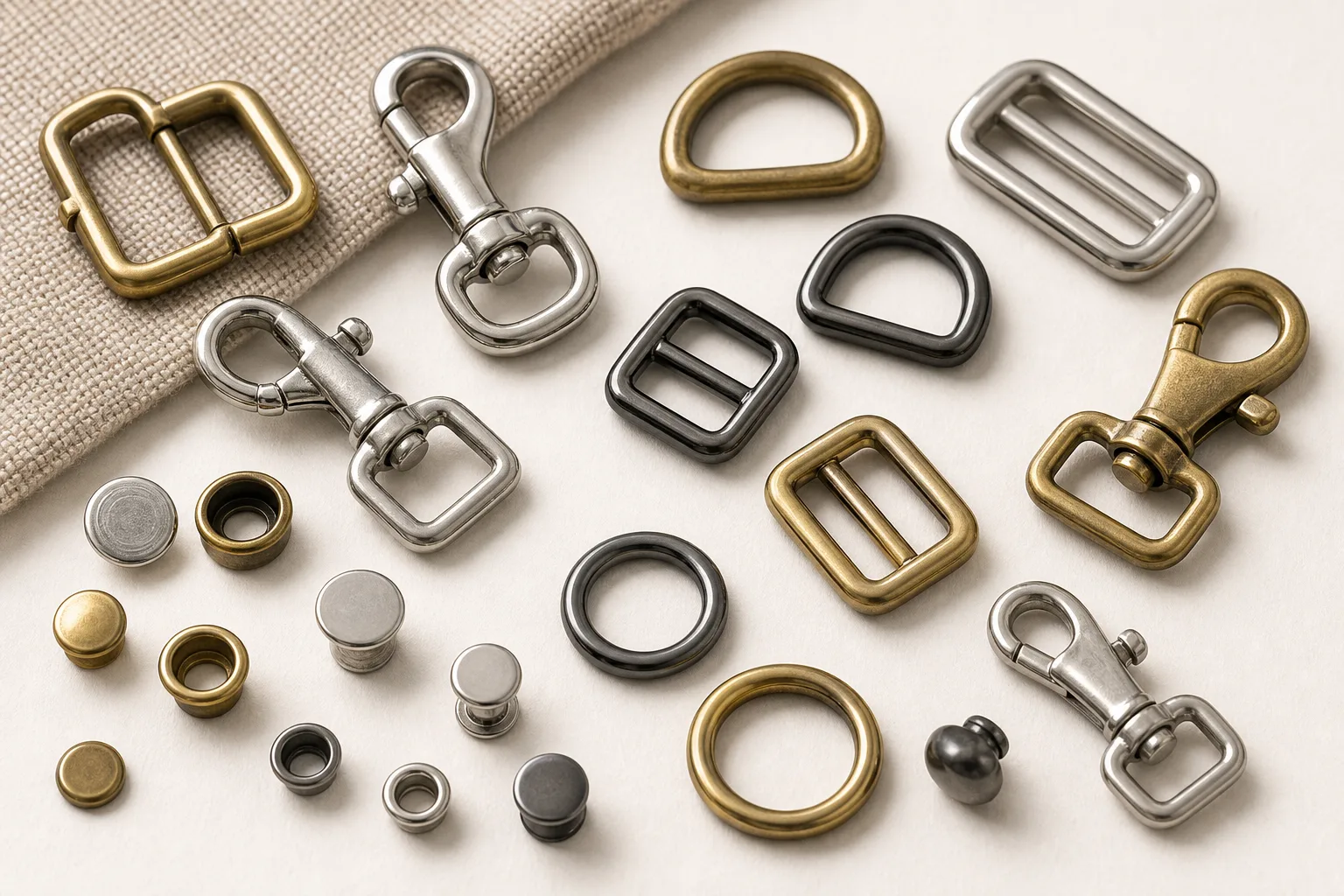
Coastal products fail at hardware more often than at fabric, and the failures cluster in a few positions. Approaching this as a whole-product material upgrade is expensive and usually unnecessary; approaching it position by position is cheaper and works better. That requires describing the environment honestly first.
Describe the environment, not the category
Coastal covers a wide range. A bag carried on a beach and rinsed afterwards, a product stored on a boat, gear used in surf and left wet, and a piece of luggage that occasionally visits the sea are four different exposure profiles.
Tell the supplier which one applies: how often, whether it is rinsed, whether it dries between uses, whether it is stored wet, and for how long the product is expected to last. Recommendations without this are guesses.
Put resistance where the surface gets damaged
Coatings protect until they are breached. In salt air, the breach is where corrosion starts, and abrasion decides where breaches happen — buckle gates, hook noses, edges that drag, anything that meets another surface.
Those are the positions where an inherently resistant material earns its cost. A hidden, protected part in the same product may be perfectly fine plated. Identifying the abrasion positions is most of the design work.
Rinsing, drying and dissimilar metals
Salt that stays on a surface keeps working. Products designed to be rinsed and dried survive better than ones that are not, and that is a design and instruction question as much as a material one.
Where different metals are in contact in a wet environment, galvanic effects become relevant. If a design puts dissimilar metals together at a joint that stays damp, raise it with the supplier rather than assuming the materials are independent.
What plastic contributes
Plastic hardware does not corrode, which is a genuine advantage in salt air, and it is why technical marine-adjacent products use it heavily. The trade-offs are ultraviolet exposure and cold behaviour, which are grade questions rather than material-family ones.
A mixed set is normal: plastic where it can carry the load, an appropriate stainless grade where metal is needed and exposed, plated parts where they are protected.
Evidence rather than claims
Salt-spray testing is the common reference, but a figure only means something with the grade, the finish specification, the geometry and the test method attached. A number quoted without those cannot be compared between suppliers.
This guide states no corrosion figures for any material or finish. The workable approach is to agree the test, the standard and the acceptance criterion in writing, and to have it run on your part rather than on a supplier coupon.
What to send with an inquiry
The exposure profile in concrete terms, the expected product life, which positions are both exposed and abraded, which are load-bearing, whether the product is rinsed and dried, whether dissimilar metals meet anywhere, and the appearance requirement.
If a previous product failed, send it. A failed part tells a supplier more about the real environment than a description does.
Coastal specification is about placing resistance where the surface will be damaged, not upgrading everything. Describe the exposure concretely, identify the abraded and exposed positions, and agree the test and standard on your own part rather than accepting general claims.
 Material Guides
 Application Guides
 Material Guides
 Comparison Guides
 Application Guides
 Material Guides