
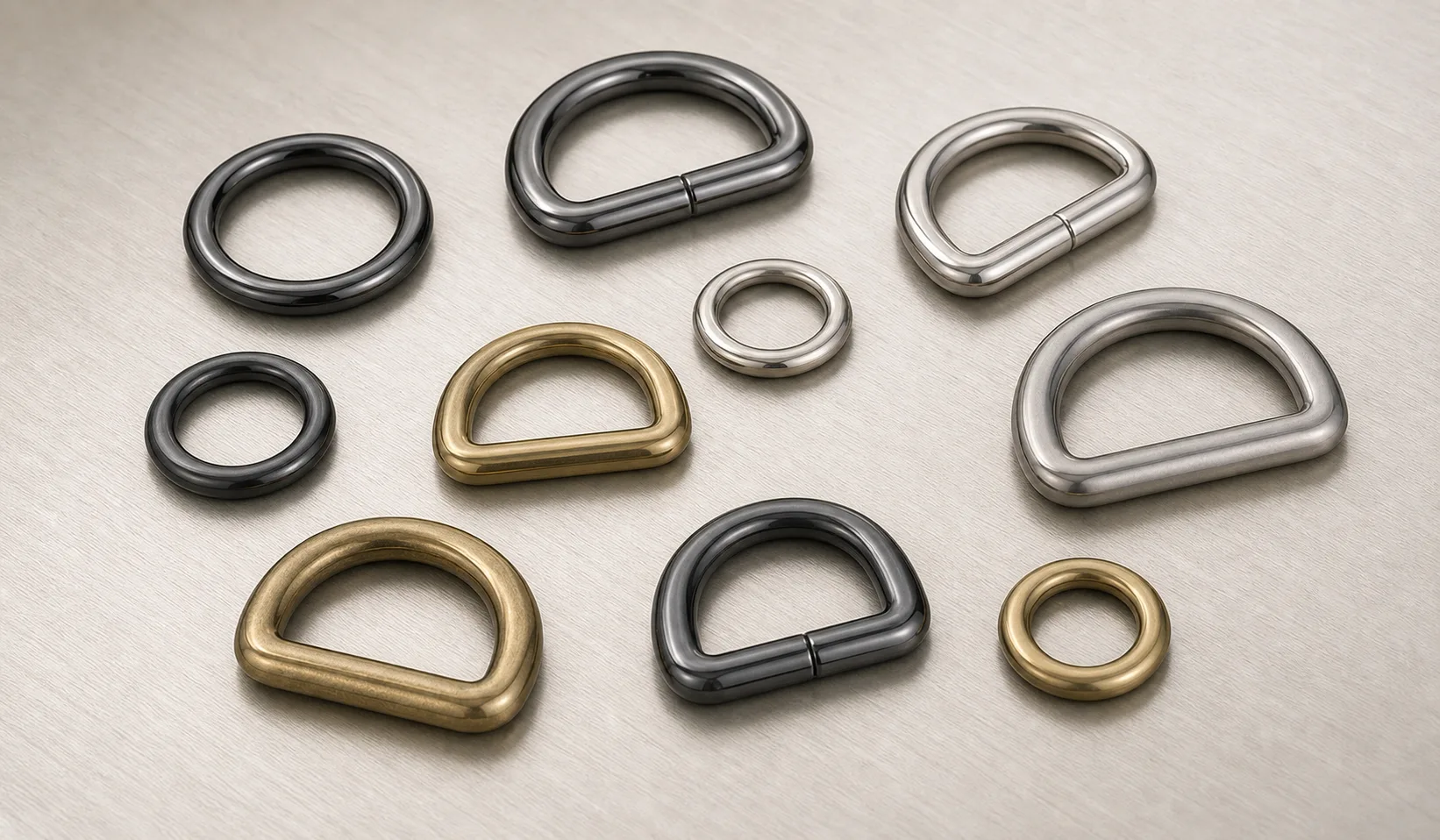
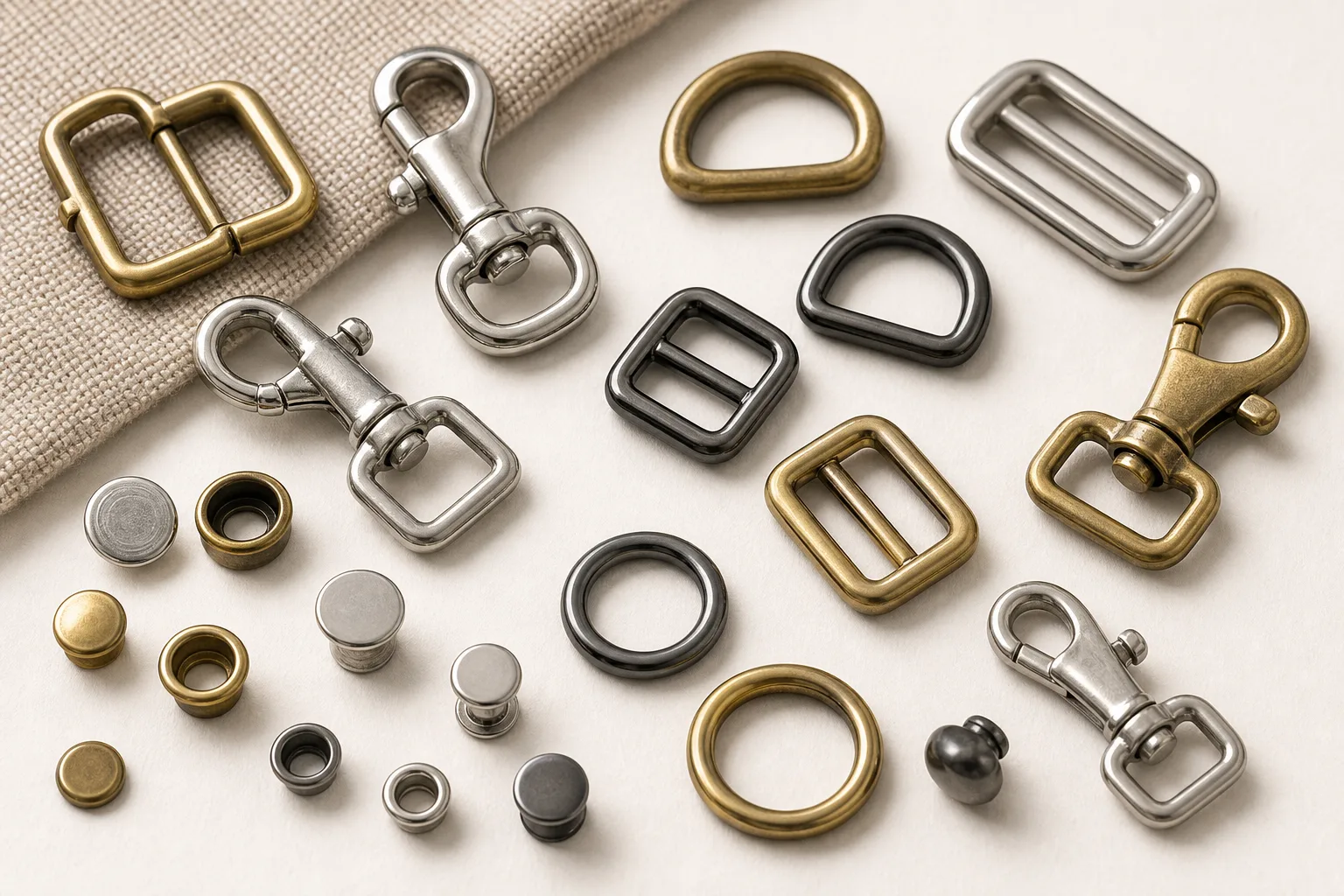
D-rings and O-rings are often listed side by side in a catalogue and priced within a few cents of each other, which makes them look interchangeable. They are not. The difference is not the shape as such but what the shape does to load direction, and choosing the wrong one usually shows up as twisting, abrasion or an attachment that will not sit flat.
What the straight bar actually does
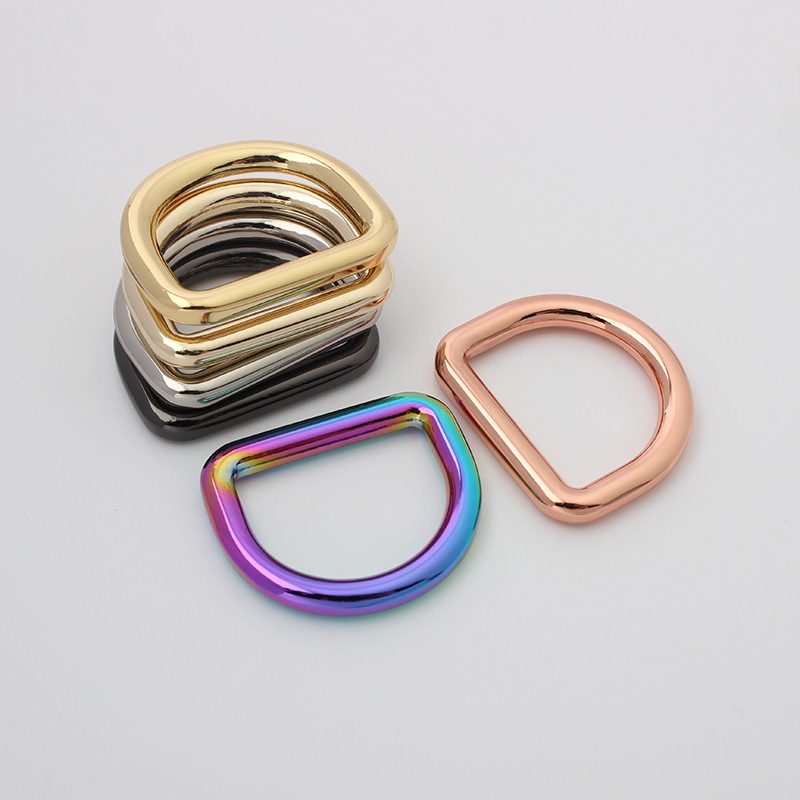
On a D-ring the straight bar is a seat. Webbing is folded over it and stitched close to the ring, so the webbing cannot travel around the ring under load. That fixes two things at once: the ring keeps a known orientation relative to the strap, and the pull always arrives at the curved side rather than at the stitch line. On a well-made assembly the stitch never sees the peak load directly.
An O-ring has no seat. Webbing sewn onto an O-ring will creep around the circle whenever the load direction changes, which is sometimes exactly what you want and sometimes the reason a strap ends up twisted after a week of use. If the ring must not rotate, an O-ring is the wrong part no matter how the sample looks on the desk.
Load direction, and why it is the real specification
Describe how the pull arrives, not just the ring size. A shoulder strap anchor pulls roughly along one axis and benefits from a fixed orientation. A leash or a swivel attachment changes direction constantly and needs the freedom an O-ring gives. A ring on a handbag flap may see almost no load at all and is chosen for appearance, in which case the discussion moves entirely to finish and profile.
Rings are also loaded off-axis more often than drawings suggest. A D-ring pulled sideways puts bending load into the straight bar, which is the thinnest part of most cast rings. If the application allows side pull, say so — it changes the sensible wire diameter and sometimes the material.
Wire diameter, inner width and how they are quoted
Two dimensions matter and they are easy to confuse in an inquiry. Inner width is the clear opening the webbing passes through and should be quoted against the webbing width plus a working allowance; too tight and the webbing bunches, too loose and it wanders. Wire diameter is the thickness of the ring section itself and is where most of the strength comes from.
Suppliers quoting to a bare number such as a 25mm D-ring are usually quoting inner width, but not always — some catalogues use the outer dimension. Sending the webbing width and asking for the inner opening removes the ambiguity in one line.
Made how: cast, welded or bent wire
Rings reach the same shape by different routes. Die-cast zinc alloy rings can carry decorative profiles and logos and hold plating well, but a casting has a parting line and internal structure that drawn wire does not. Welded steel or brass wire rings have a joint that must be finished so it does not abrade webbing, and where the weld sits relative to the load matters. Bent wire rings with an open joint are cheapest and appropriate only for light, non-structural use, because an open joint will spread under load.
None of these is a quality ranking. A cast decorative ring on a fashion bag and a welded ring on a load strap are both correct choices for their jobs. What causes trouble is a decorative construction quietly substituted into a structural position.
Where each one belongs
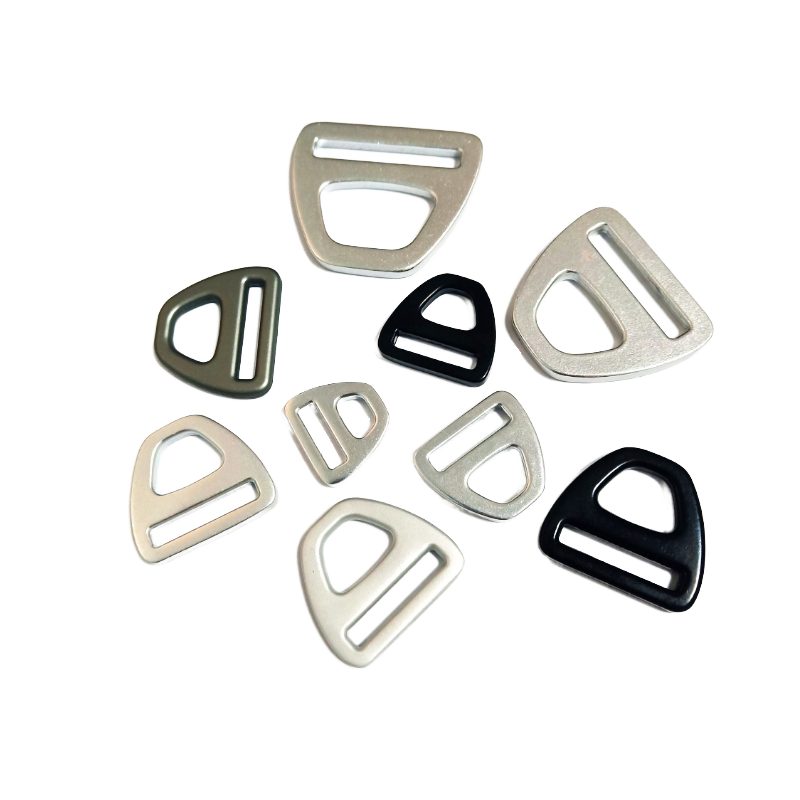
D-rings suit shoulder strap anchors, backpack attachment loops, belt keepers and any point where a hook should approach from a predictable direction. O-rings suit swivel points, pet leash hardware, connectors that must self-align, and decorative rings on trims where rotation does not matter.
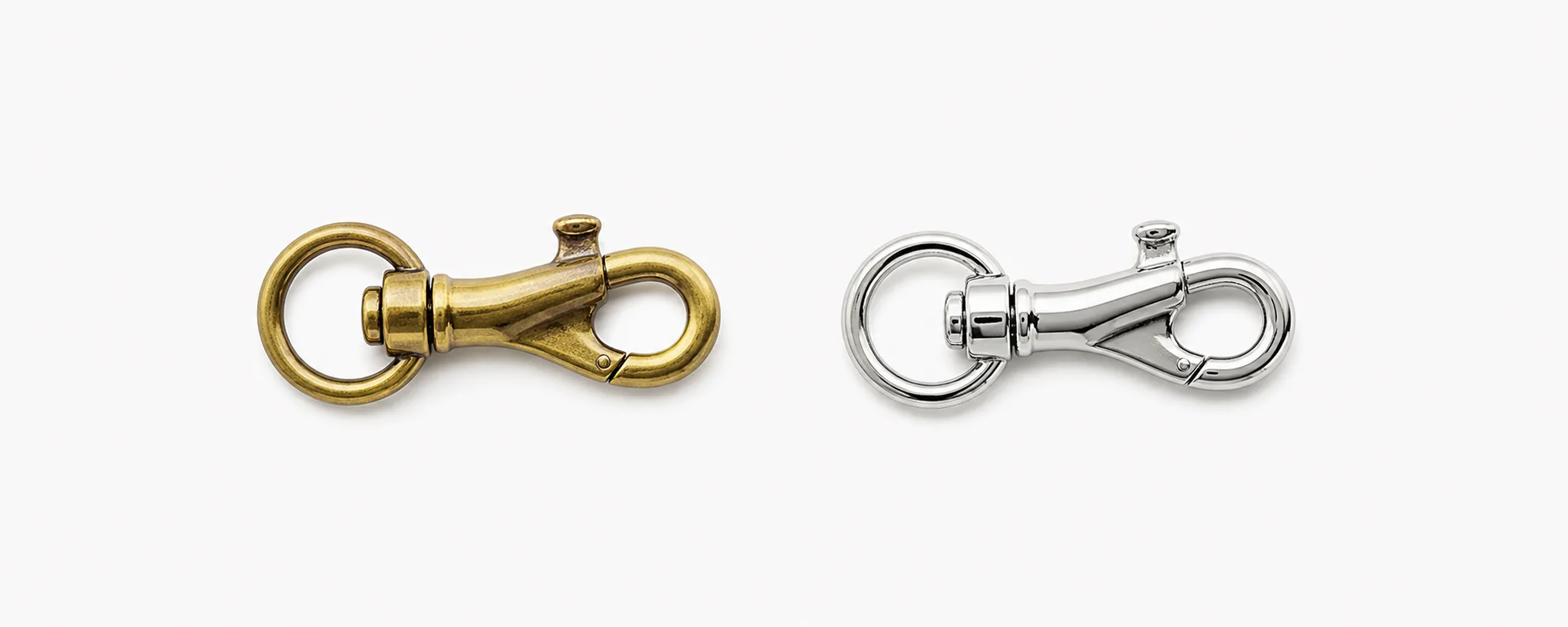
Mixed assemblies are common and sensible: a D-ring sewn to the bag body paired with a swivel snap hook on the strap gives fixed orientation on one side and rotation on the other, which is usually what a user actually wants from a shoulder strap.
What to put in the inquiry
Ring type, inner width, wire diameter, webbing width and thickness, how the ring is attached, whether rotation is wanted or must be prevented, and whether the load can arrive off-axis. Add material and finish direction, and say if the ring is visible on the finished product — a visible ring moves the conversation toward casting and plating consistency, a hidden one toward section strength.
If you have a reference sample, a photograph of it next to a ruler answers more questions than a description. If you have a drawing, mark which dimension is the inner opening.
Choose the ring by what you want the load to do, not by which shape looks neater in the catalogue. A D-ring fixes orientation and directs pull to the curve; an O-ring gives rotation and gives up that control. Once the behavior is settled, inner width, wire diameter and construction follow from it.
 Buyer Guides
 Material Guides
 Application Guides
 Buyer Guides
 Buyer Guides