
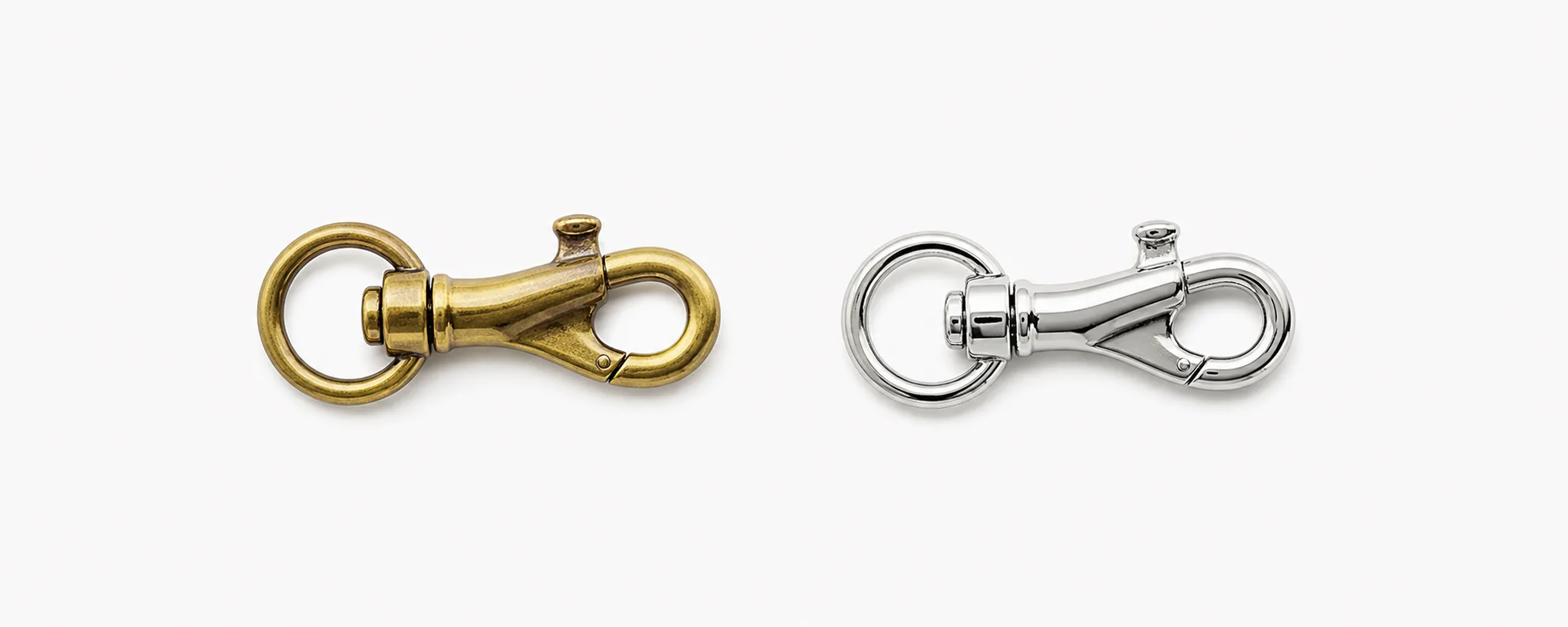
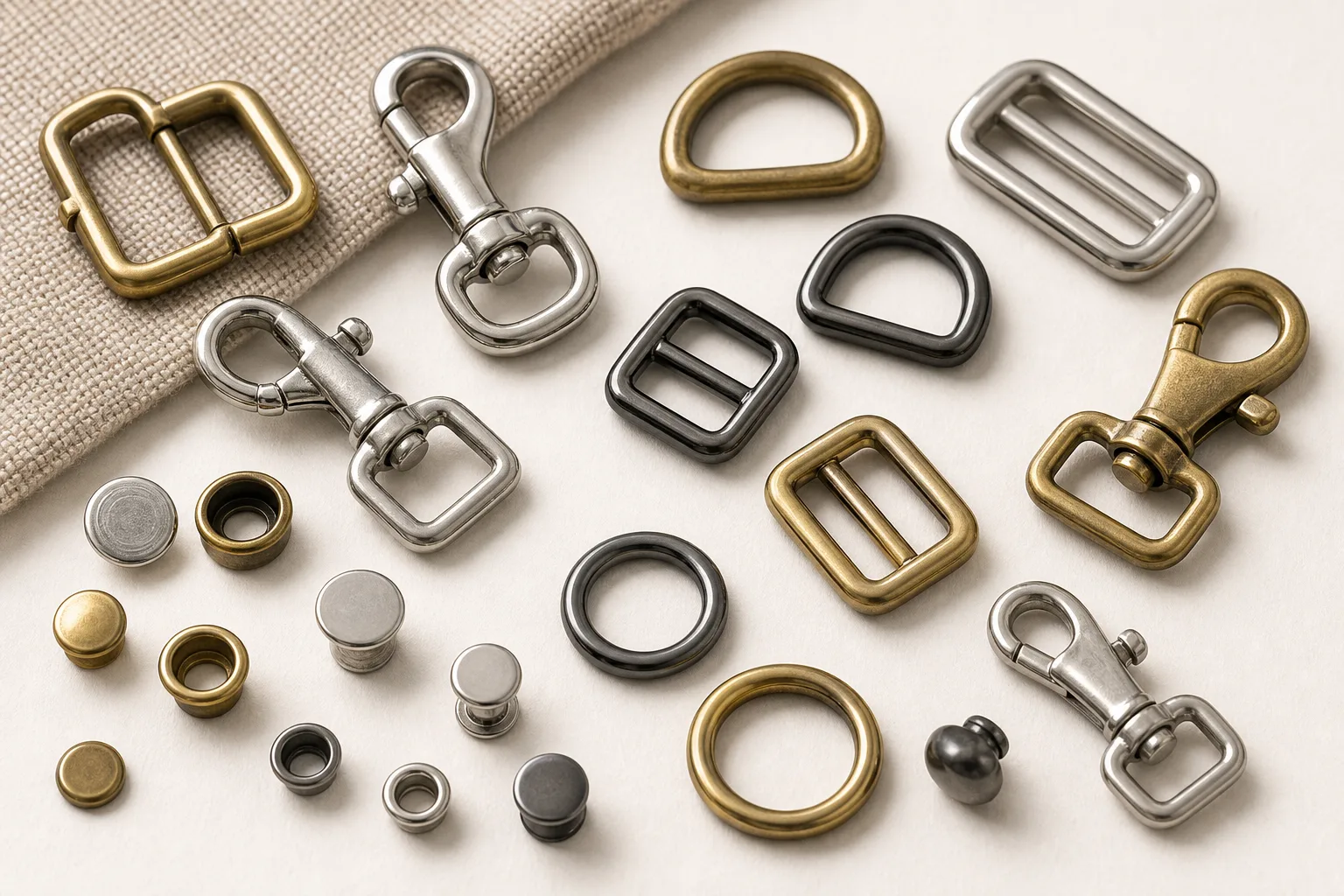
Few hardware terms cause as much back-and-forth as hook naming. Buyers ask for a swivel hook and receive a fixed-base hook with a swivel eye; they ask for a trigger hook and receive a bolt snap. The confusion is structural rather than careless: the words describe different features, and catalogues combine them inconsistently. Splitting them apart makes inquiries much shorter.
Three features, not three products
Think of a hook as three decisions. First, how does it open — a spring gate that pushes inward, a thumb lever that pulls back, a screw gate, or nothing at all on a fixed hook. Second, does the base rotate — a swivel base turns on a rivet or post, a fixed base does not. Third, what does it attach to — a flat eye for webbing, a round eye for cord, a D-shaped eye, or a swivel eye that turns independently of the base.
Once these are separated, most naming disputes disappear. A swivel trigger snap hook with a 25mm flat eye is unambiguous. A swivel hook on its own is not.
The gate is the part that fails first
Whatever the hook is called, the gate is the moving assembly, and moving assemblies are where wear concentrates. A spring gate depends on a small spring under repeated compression; a trigger depends on a lever pivot and its return spring. Both can develop play long before the hook body shows any sign of wear, and play in a gate usually means it stops closing fully.
Where a hook is opened many times a day, say so in the inquiry. It changes the sensible construction, and it is the kind of requirement that is expensive to discover after bulk production.
Swivel: when rotation helps and when it hurts
A swivel base lets a strap untwist itself. On a shoulder strap, a pet leash or anything that gets picked up and put down repeatedly, this is worth having. On a fixed attachment that should stay aligned — a hook sitting flat against a panel, or one carrying a logo that should stay upright — rotation is a defect.
Swivels are also a wear point. The joint is a rivet or a peened post that carries load while rotating, and it will loosen before a solid body does. If rotation is not needed, a fixed base removes a failure mode at no cost.
Eye type and webbing fit
The eye is where most sizing errors happen. A flat eye takes webbing and should be quoted against webbing width; a round eye takes cord or a split ring. The eye opening needs to suit webbing thickness as well as width — a 25mm eye sized for thin polyester will bunch a thick, coated 25mm webbing.
When the hook attaches to a sewn loop rather than passing through, the eye still matters: it sets how the loop folds and therefore how the stitch is loaded. Send the webbing specification, not only the nominal width.
Material and finish, briefly
Hooks are made in zinc alloy, brass, steel and stainless steel, and each behaves differently in a moving assembly. Cast hooks carry decorative profiles well; wrought or stamped hooks suit thinner, stronger sections. Because the gate and the swivel both move, plating on contact faces wears differently from plating on a static ring — a finish that looks identical on day one may not after a season.
This guide does not state performance figures for any material or finish, because those depend on the confirmed structure, the plating specification and the test method. Ask for samples and agree what will be checked.
What to specify
Gate type, base type (swivel or fixed), eye type and inner width, webbing width and thickness, overall length, how often the hook is opened, whether the hook is visible, and material and finish direction. Where the hook is part of a set — hook plus D-ring plus adjuster — quote the set together so proportions and finishes match.
A reference sample shortens this considerably. If you have one, note which parts of it you want kept and which you want changed; a supplier matching an entire sample when you only wanted the gate style will quote the wrong tooling.
Snap, swivel and trigger are three independent attributes: how the gate opens, whether the base turns, and how it is operated. Name all three plus the eye and the webbing, and the part is fully identified. Leaving any of them implicit is what produces the wrong sample.

 Buyer Guides
 Application Guides
 Buyer Guides
 Buyer Guides
 Comparison Guides