OEM / ODM Hardware Manufacturing

Packing and Labeling Options for Hardware

How hardware packing protects finishes in transit, what inner and outer packing each do, and which labelling details matter downstream.

15+ Years Industry ExperienceOEM/ODM Custom SolutionsQC Ready Global StandardsFast Lead Sample Support
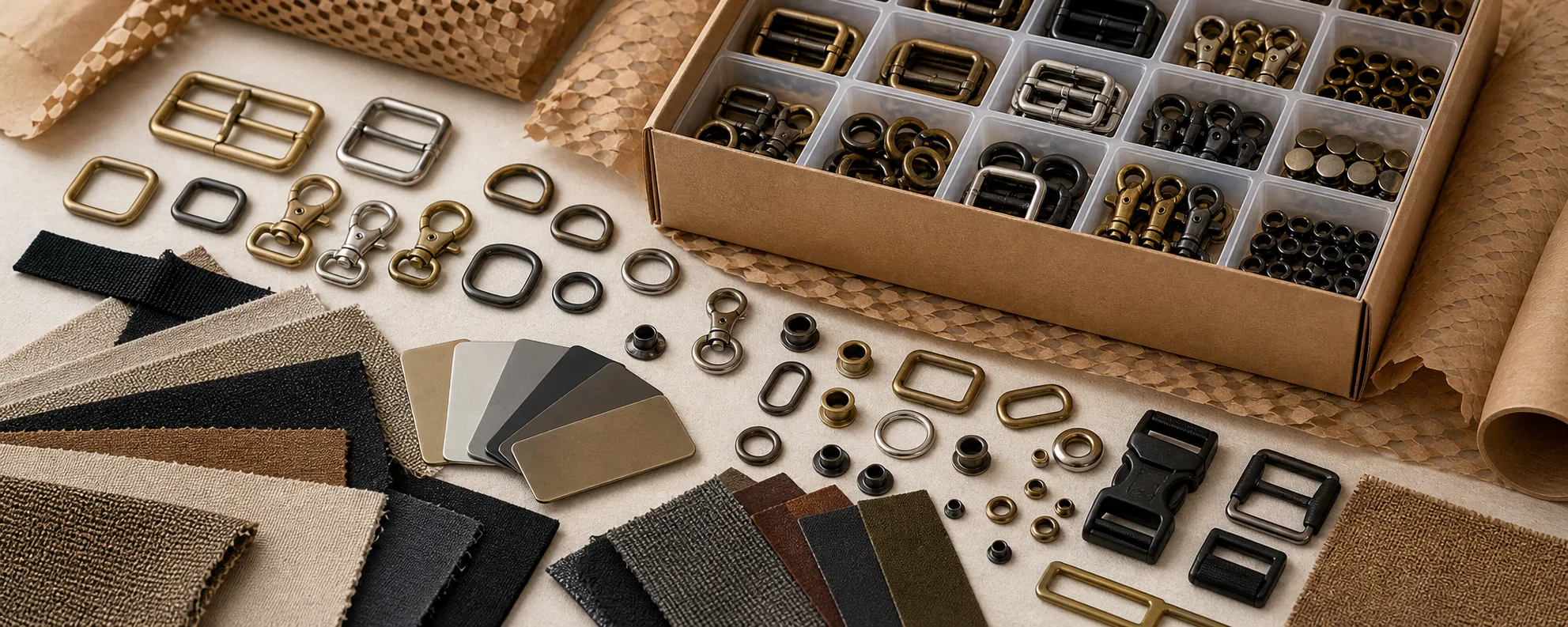
Photorealistic hardware product assortment for related buyer guide products

Article guidance connected to products and RFQ actions

Buyer guides should lead into material/finish decisions, related product categories, downloadable checklists and expert review.

Direct Answer

Guide

Packing is usually the last item discussed and one of the more common causes of a rejected delivery. Metal parts moving against each other over a long shipment will mark each other, and a carton that cannot be identified without opening it creates work for the rest of its life.

Inner packing protects the finish

Finished parts in bulk rub during handling and transit. Depending on the finish, that ranges from harmless to a delivery-rejecting problem, and the softer or more decorative the finish, the more it matters.

The options run from loose bulk in a bag, through counted bags, to individually wrapped or compartmented packing. Cost rises along that scale, so match it to the finish rather than applying the highest level everywhere.

Counting units and how they are used downstream

Whether parts arrive in bags of a fixed count, in bulk by weight, or in kits matched to a garment set changes how much handling your own operation does.

A polybag count that matches your production batch size removes a counting operation entirely. That is often worth more than the packing difference costs.

Outer packing and transit conditions

Carton strength, stacking, weight per carton and moisture protection all depend on the shipping mode and the route. Sea freight involves humidity and long handling chains; air freight is shorter but handled more.

State the shipping mode and any known storage conditions. Where parts are moisture-sensitive, this is the point at which protection should be specified rather than assumed.

Labelling that your warehouse can act on

A carton label should let a receiving operator identify the part, the variant, the quantity and the order without opening it. Where you use barcodes or a specific label format, provide the specification rather than describing it.

Include the requirements for both inner bag labels and outer carton labels. They are frequently different and are frequently confused.

Retail and presentation packing

Where hardware is sold as a spare, a kit or a branded accessory, presentation packing becomes part of the product and needs artwork, materials and approval in the same way the part does.

Treat it as a separate specification with its own approval, not as a packing note appended to the hardware order.

What to specify

Inner packing type and count per unit, whether variants may share a carton, outer carton specification and maximum weight, moisture protection, shipping mode, inner and outer label content and format, any documents to be included, and any retail packing with its artwork.

Send a label template if you have one. Label format problems are trivial to prevent and irritating to correct after arrival.

Specify inner packing against the finish, outer packing against the shipping mode, and labelling against your own receiving process. Matching pack counts to your production batches often saves more than it costs.
Key Terms

Inner packing

How parts are contained within a carton — bulk, counted bags, individual wrap — chosen to stop finished surfaces rubbing in transit.

Pack count

The quantity per inner unit, which determines how much counting and handling the receiving operation has to do.

Buyer Checklist

  • Inner packing type and count per unit
  • Whether variants may share a carton
  • Outer carton specification and max weight
  • Moisture protection requirement
  • Shipping mode
  • Inner and outer label content and format
  • Documents to be included
  • Retail packing and artwork if any

Key Takeaways

Match inner packing to how delicate the finish is, set pack counts to your own batch size, and supply a label template rather than describing the format.

  • Delicate finishes need packing that stops part-to-part contact
  • Pack counts matched to your batch size remove a counting step
  • Outer packing follows the shipping mode
  • Inner and outer labels are separate specifications

FAQ

Which materials and finishes are available for Packing and Labeling Options for Hardware?

Packing and Labeling Options for Hardware is quoted in Zinc Alloy and Brass. Available surface finishes are Gold, Antique Brass and Painted Finish. Material and finish are quoted together, because tooling and plating cost change with the combination.

What is Packing and Labeling Options for Hardware used for?

On this site Packing and Labeling Options for Hardware is catalogued under Bags & Handbags and Garments. End use decides the specification that gets quoted — load, exposure and washing requirements differ between them, so state the end use in the RFQ rather than the part name alone.

Where does Packing and Labeling Options for Hardware sit in the product range?

Packing and Labeling Options for Hardware appears in Bag Hardware, Decorative Metal Trims and Custom Logo Hardware. Related items in the same category can be quoted on one RFQ, which is usually how buyers keep finish and packaging consistent across a set.

What should buyers prepare before sending a Packing and Labeling Options for Hardware RFQ?

Prepare product type, application, material, finish, size, quantity, logo requirement, sample expectation and any testing or document request.

Can Packing and Labeling Options for Hardware samples be requested before bulk production?

Yes. Sample availability and timing should be reviewed by product structure, material, finish and buyer requirements.

Can testing documents be provided for Packing and Labeling Options for Hardware?

Testing or compliance documents depend on actual material, finish, testing scope and available records. Requirements should be confirmed before sampling.

Start Your Project

Request a Quote

Send article context with product, application, material, finish and testing requirements so the sourcing team can review the request.

RFQ
+86 151 7024 4792info@nceco.cn