
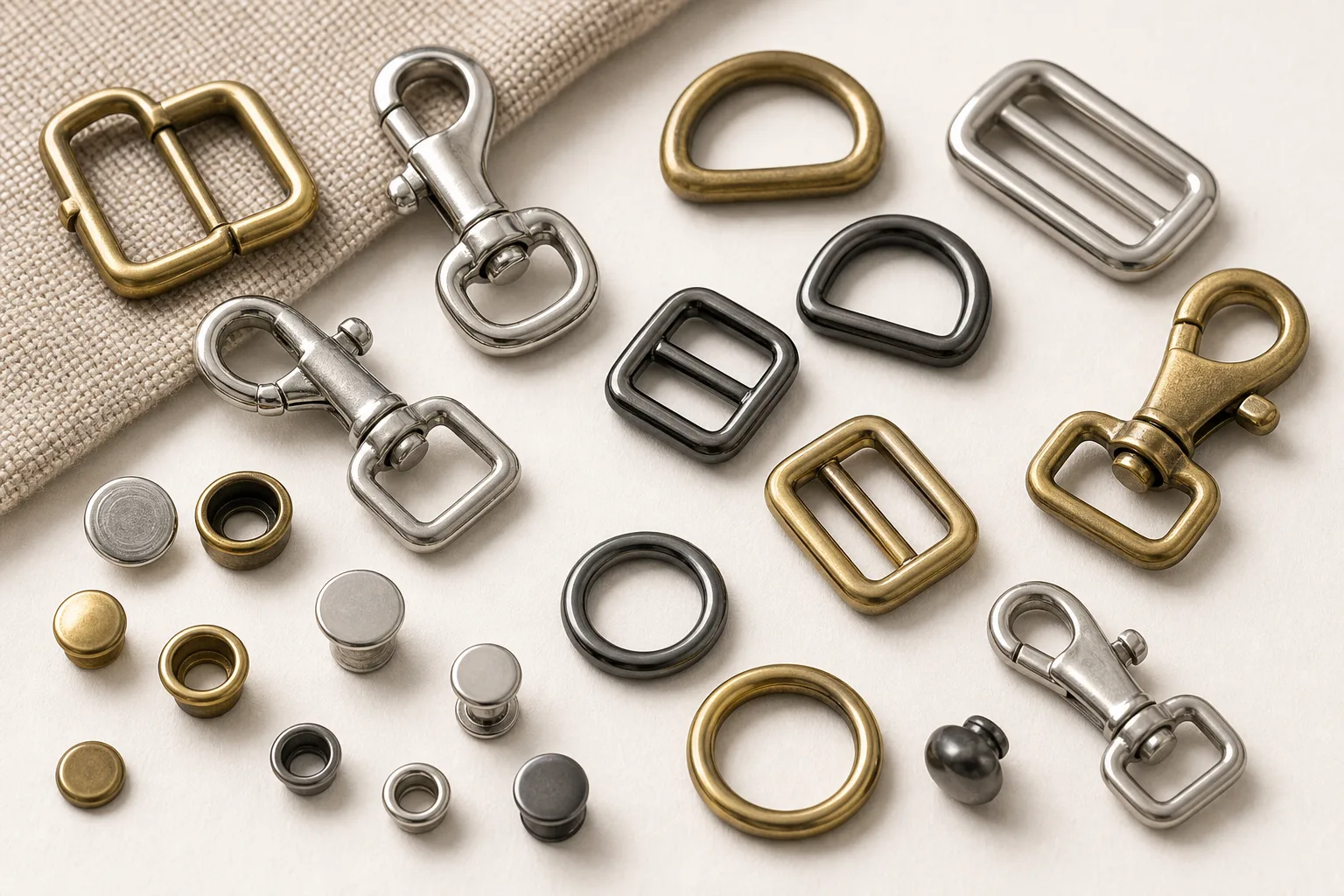
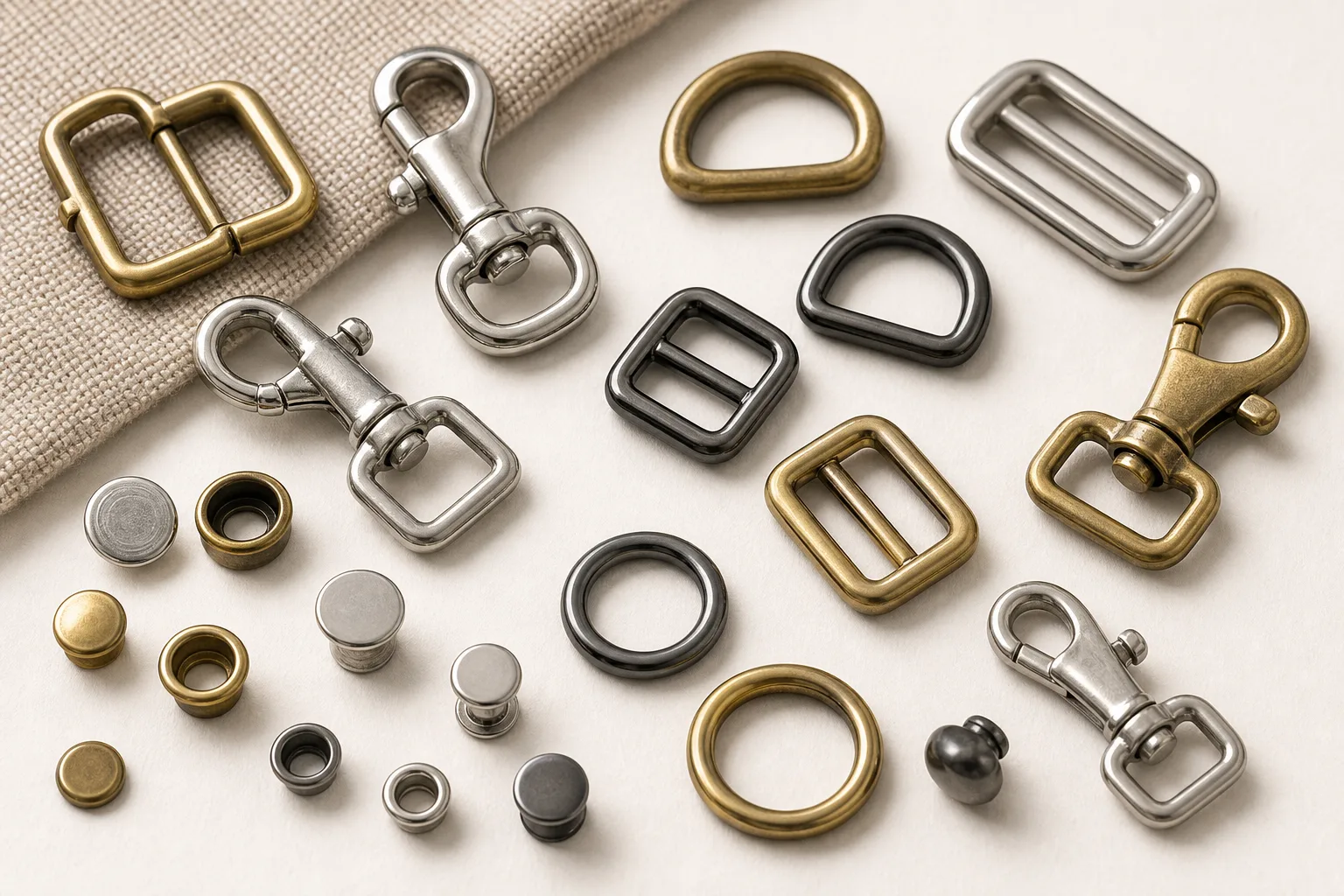
Iron gets specified for one reason and it is a good one: cost at volume on simple parts. The question is not whether that is legitimate but where the boundary sits, because the failure mode is not a broken part — it is a rust mark on a customer garment.
What iron is good at
Stamping and wire forming are fast, the tooling for a simple shape is inexpensive, and the piece cost at volume is low. For plain eyelets, basic rings, simple button backs and internal components, that is a real advantage on a product with hundreds of trims.
It is also strong in thin section, being a wrought material. A stamped iron part can be thinner than a cast equivalent and still carry load, which suits flat components.
The coating is the whole defence
Iron has no inherent corrosion resistance in this context. Whatever protection exists comes from the plating or coating, and once that is breached at a scratch, an abraded edge or a poorly covered recess, the exposed iron is on its own.
Because iron corrosion spreads under the surrounding coating and migrates onto adjacent material, a small breach becomes a visible problem. On hardware, the consequence is usually a stain on fabric rather than a failed part.
The two situations that catch it out
Garment washing puts the trim into water with chemistry at a point where the coating may have been stressed by setting. Any weakness shows there rather than in the factory, and it shows on the finished garment.
Long humid storage does the same slowly. A product can leave the factory clean and arrive at a distributor marked, which is a costly and avoidable failure. Both situations are foreseeable, so both belong in the specification conversation.
Where the line sits
Hidden, dry, high-volume, low-consequence positions are where iron makes sense: internal components, parts behind linings, trims on products that are not washed.
Visible positions, anything against pale or delicate fabric, anything on a washed garment, and anything on a product stored or used in humidity are where the saving is not worth the risk. That is a judgement, but it should be made explicitly rather than by default.
Managing the risk in the specification
State the coating requirement rather than accepting whatever is standard. Ask what happens at cut edges, which is where a stamped part is most vulnerable. Run a wash trial with the real parts if the product is washed, and state the storage and shipping assumption.
This guide does not state how long any coating will protect an iron part, because it depends on the coating specification, the edge condition and the exposure. If it matters, agree the test and the standard.
What to send with an inquiry
The part geometry, whether the position is visible, the fabric it sits against and its colour, the process the product goes through after assembly, expected storage and shipping conditions, the coating requirement, and quantity.
Where a product has both hidden and visible trims, split the list. Quoting the whole set in iron because part of it can be is how visible parts end up wrong.
Iron is a legitimate choice for simple, hidden, dry, high-volume parts, and a poor one where it is visible, washed or against pale fabric. The failure mode is a stain on a customer garment, so the decision should be made position by position rather than for a whole set.
 Comparison Guides
 Application Guides
 Material Guides
 Finish Guides
 Application Guides
 Application Guides