
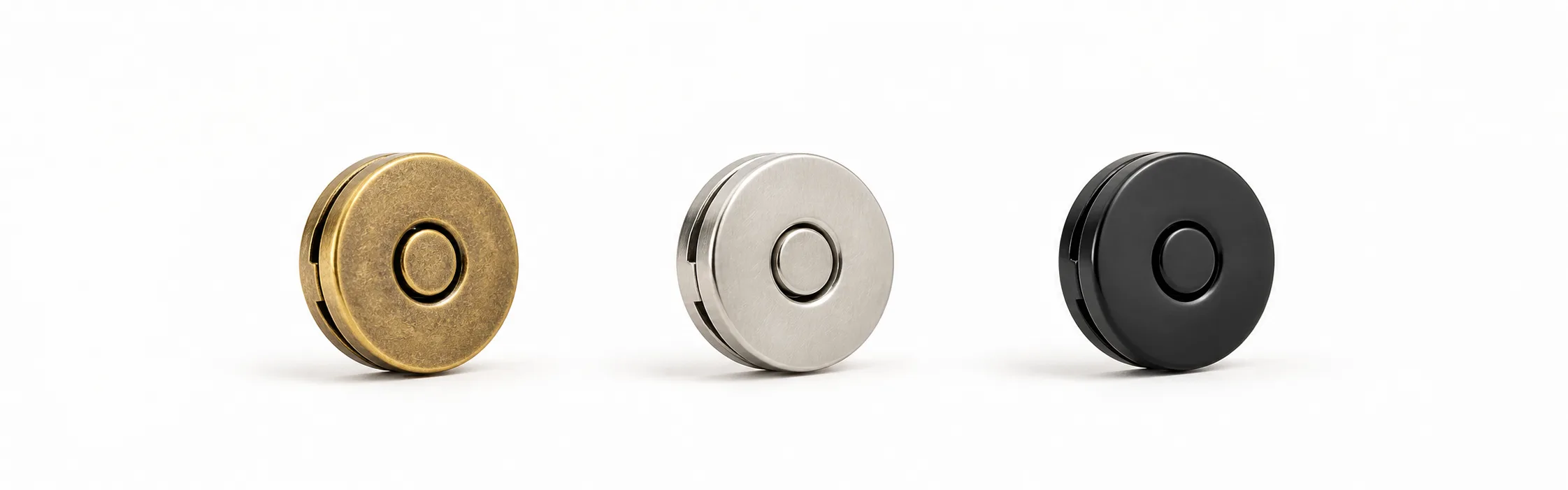
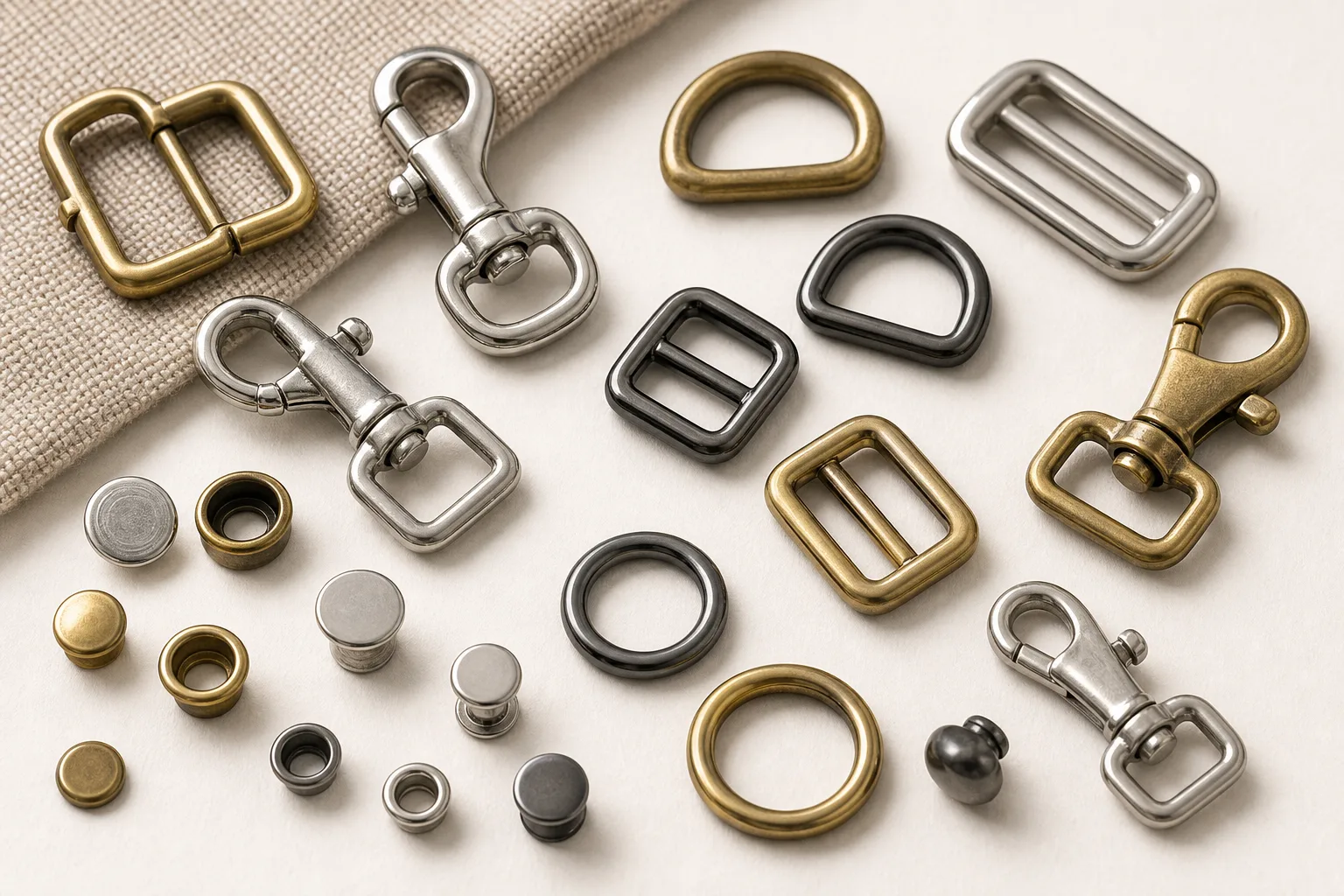
Magnetic closures are chosen for a specific reason: they let a bag close cleanly with no visible hardware and no fiddling. That advantage disappears if the closure is too weak to hold a full bag or so strong that opening it distorts the flap. Both outcomes are usually placement problems rather than magnet problems, which is what this guide focuses on.
How the closure is built
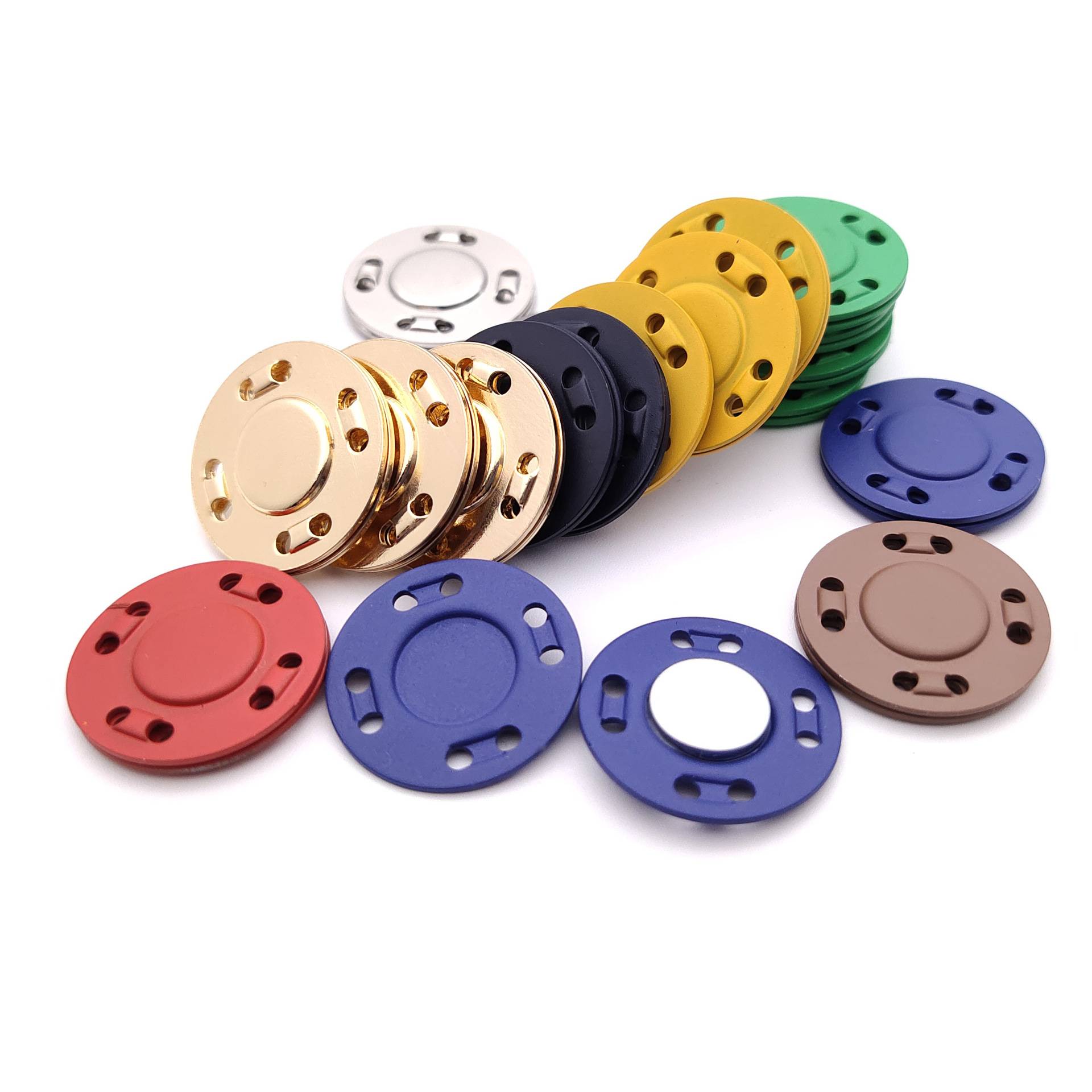
A magnetic snap is two discs. One carries the magnet, the other is a steel plate or a second magnet, and each is fixed to its panel by a back part. Prong backs have two flat tongues that pass through slits in the material and fold over a washer. Sew-on types have a flange with holes and are stitched. Rivet-backed types are set with a press like a rivet.
The back type is chosen by what the panel can take. Prong backs need a slit and a washer and are the usual choice on leather and on lined bag flaps. Sew-on types suit soft or thin materials where prongs would show or pull. Rivet backs suit production lines already set up for pressing.
Why placement decides the felt strength
A magnetic closure on a flap is opened by a lever. The user pulls at the edge of the flap, and the distance from that edge to the magnet is the lever arm. Move the magnet closer to the fold and the same magnet feels much stronger to the user; move it toward the flap edge and it feels weaker.
This is why two bags with identical magnets can feel completely different. When a sample closes too easily, the first thing to check is not the magnet grade but where it sits relative to the flap edge and the fold. Changing position is usually cheaper and more effective than changing part.
Alignment and how the panels meet
The two discs have to meet squarely. If the flap approaches at an angle, the contact is partial and the closure feels weak regardless of the magnet. On a soft unstructured bag the flap will find its own angle, which is why magnetic closures work better with some structure behind the panel — an interlining or a stiffener disc.
Alignment also drifts as a bag fills. A closure that meets perfectly on an empty bag may meet at an angle when the bag is full, which is the condition in which the user actually needs it to hold. Test on a filled bag.
What magnetic closures are not good at
They are not security fastenings; anything that opens by pulling will open if pulled. They are not ideal next to items sensitive to magnetic fields, which is worth noting on bags intended to carry cards or devices — the practical placement answer is usually to move the closure away from a card pocket rather than to change the part.
They also add two rigid discs to a panel. On a very soft or thin material that shows through, the outline can be visible from the face. A stiffener or a slightly heavier lining usually solves this, but it is better designed in than discovered at sample stage.
Materials, finish and visibility
Most magnetic snaps are hidden behind a lining, in which case finish matters only for corrosion resistance in the intended environment. Where the closure is visible — an exposed disc on the outer face of a flap, or a decorative cap over the magnet — it joins the rest of the hardware set and should match it in finish and profile.
This guide does not state holding force figures for any type or size, because the felt result depends on placement, lever arm, panel structure and how the bag is loaded. Ask for samples and evaluate them on a made-up flap rather than on a flat table.
What to specify
Back type (prong, sew-on, rivet), disc diameter, panel material and thickness, whether the closure is hidden or visible, the distance from the magnet position to the flap edge and to the fold, whether the panel has a stiffener, and material and finish direction.
If you have a bag whose closure feels right, say so and send it. Matching a known feel is far more reliable than agreeing on a number, because the number does not capture the lever arm.
A magnetic closure is a system of magnet, panel structure and geometry. Placement relative to the flap edge and the fold changes the felt strength more than the part does, so fix the position before changing the hardware. Evaluate samples on a made-up, loaded bag rather than flat.
 Buyer Guides
 Buyer Guides
 Material Guides
 Quality Guides
 Buyer Guides
 Buyer Guides