
When hardware has to carry a brand colour, coating is usually the only route. It brings a specific set of consequences — coverage behaviour, detail softening, edge wear — that are easy to manage if they are discussed at specification stage and awkward if they are discovered on a production sample.
Colour freedom is the reason
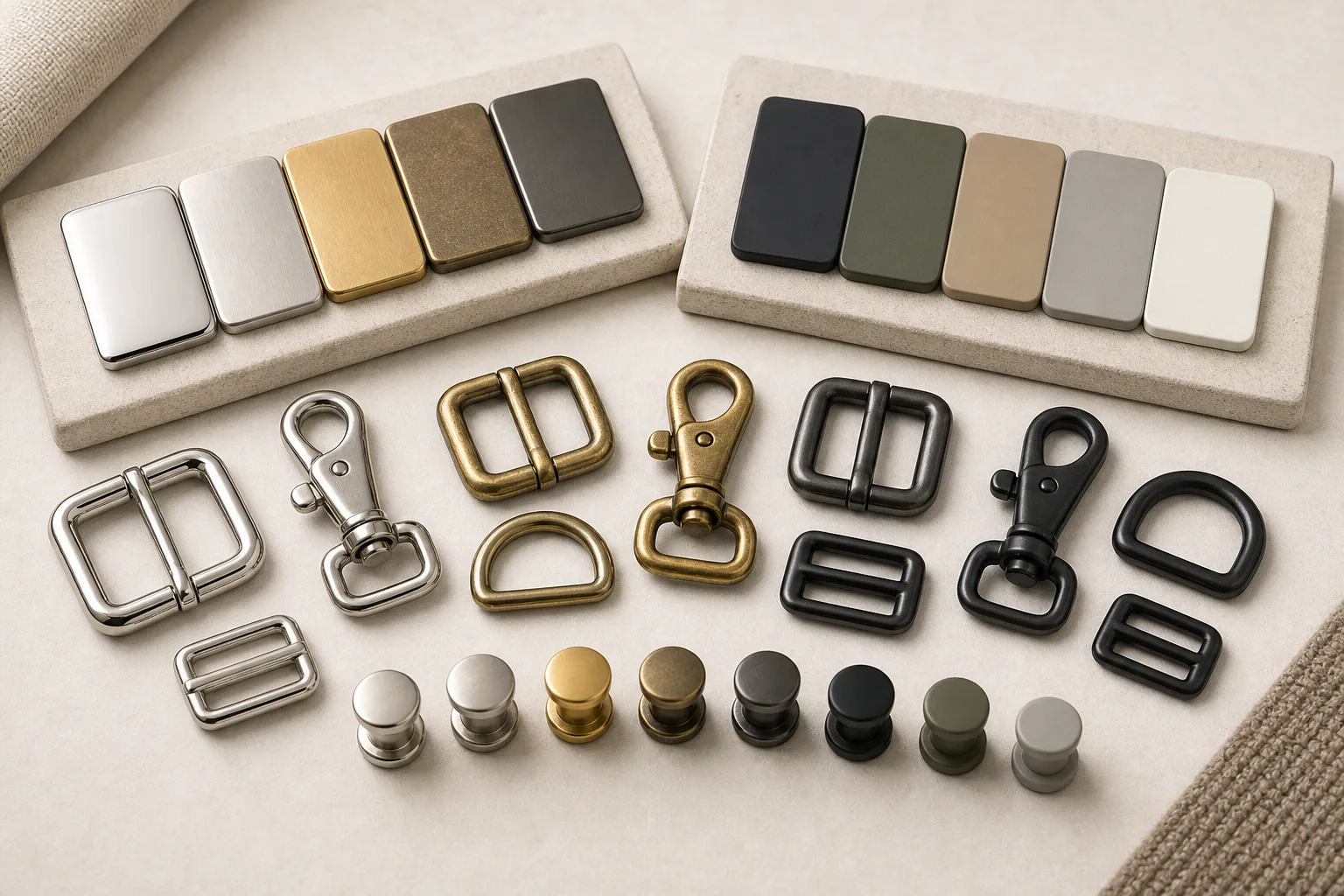
Plating gives metallic tones. Coating gives flat colours, brand colours, textures and controllable gloss levels. If a brand palette has to appear on metal hardware, this is the route, and that is a capability difference rather than a quality one.
Colour matching is done against a physical reference and, where the hardware must match a fabric or a printed label, against that material rather than a standalone chip.
How coverage behaves on a shape
Liquid coatings pull away from sharp edges and pool slightly in recesses, so thickness is not uniform over a shaped part. Edges end up thinnest and recesses thickest.
On a part with fine relief, the extra thickness in recesses can soften the detail, reducing the crispness of a moulded logo. Where detail must stay sharp, discuss it before choosing the finish.
Partial colour and masking
Where only part of a surface is coloured, the boundary is defined by masking, printing or pad application. That boundary is only as repeatable as the method, and small variations show at small scale.
For a fine logo outline, an enamel fill in a tooled recess gives a harder edge. For broad colour areas, masking is normally fine. Choose by how crisp the boundary has to be.
How damage shows
A scratch through a coloured coating exposes whatever is underneath, usually with high contrast, so damage is visible. Edges being thinnest, that is where it starts.
Design responses are to radius edges, choose lower-contact positions, or select a colour and gloss level where wear reads as acceptable. Very dark and very light coatings both show damage clearly.
What the product process adds
Washing, pressing and garment dyeing act on coatings. On denim programmes, some coating wear is intended and part of the look; on other products it is a defect.
Run the trial with the coated parts on the real material and approve after the process. This guide states no adhesion or abrasion figures, because they depend on the coating system, the substrate preparation and the test.
What to specify
Colour with a physical reference and the material it must match, gloss level, whether colour is full or partial and how boundaries are defined, edge treatment, whether fine detail must stay crisp, the process after assembly, and quantity.
Ask what substrate preparation the coating requires. As with plating, most adhesion problems originate before the visible layer goes on.
Coating buys colour freedom that plating cannot offer, at the cost of thinner coverage at edges and some softening of fine detail. Specify colour against the material it must match, decide how boundaries are defined, and treat edges as the wear point.
 Finish Guides
 Finish Guides
 Finish Guides
 Finish Guides
 Finish Guides
 Finish Guides
 Material Guides
 Material Guides